
In its fiscal quarter that ended on 3 September, Micron posted a gross margin of 86.8 percent. In other words, it cost Micron barely more than $13 to make every $100 of memory it sold. That tops the 75.0 percent that Nvidia, one of the biggest buyers of memory, reported for its quarter that ended in July. According to Samsung’s final third-quarter results, released on 29 October, the South Korean company’s operating profit reached 107.4 trillion won, nearly nine times the year-earlier figure.
Memory is one of the most cyclical corners of the chip business, and record years have usually ended in overbuilding and a price crash. Investors have to decide what, if anything, will hold these margins up this time. In an earlier piece, I looked at how the big cloud providers are borrowing to pay for AI. This one looks at the other end of the supply chain: the companies that make the memory.
Why the Industry Can’t Make More Memory Fast
The bottleneck is HBM, or high-bandwidth memory, which stacks DRAM chips on top of one another, sits right next to an AI accelerator and moves data many times faster than ordinary memory. TrendForce says HBM and conventional DRAM are competing for the same scarce production capacity, and SemiAnalysis estimates that a wafer turned into conventional DRAM yields more than three times as much memory as the same wafer turned into HBM. Every wafer devoted to HBM means less memory for laptops, phones and ordinary servers.
Capacity is also slow to add. Chey Tae-won, chairman of SK Group, said in March that new capacity takes at least four to five years to bring online, and that he expects the industry’s supply shortfall to stay above 20 percent through 2030. In its late-September outlook, Micron forecast that industry DRAM supply, measured in bits, will grow only in the low-20s percent range in both 2027 and 2028. Buyers have adjusted. Nvidia’s supply and capacity commitments jumped from $119 billion to $279 billion in a single quarter, mostly to secure memory, according to the company’s CFO commentary. Some 96 percent of that total comes due by early 2029.
Contracts Are the New Business Model
On its 30 September earnings call, Micron said it had signed 26 strategic customer agreements and estimated that they would cover more than 35 percent of its revenue through 2030. All of them are take-or-pay, so the customer pays for the contracted volume whether or not it takes delivery. Customers have committed $32 billion, mostly as cash deposits. Those deposits show up on Micron’s balance sheet, where long-term customer contract liabilities rose from $0.57 billion to $12.90 billion in one quarter. Micron hands the cash back gradually over the second half of each agreement, provided the customer meets its minimum purchase commitments, so the deposit is, in effect, a guarantee that the buyer will take what it signed up for.
Pricing matters as much as volume. Three-quarters of the expected contract revenue falls under set pricing terms, mostly floor and ceiling prices, and the rest tracks the market. Micron has already signed contracts for the vast majority of its 2027 HBM output at significant year-on-year price increases. The structure protects Micron if prices fall but caps what it earns if they keep climbing. TrendForce expects the effect to show up as early as the fourth quarter, when some suppliers’ server DRAM price increases should trail the market average because of pricing terms in their long-term agreements.
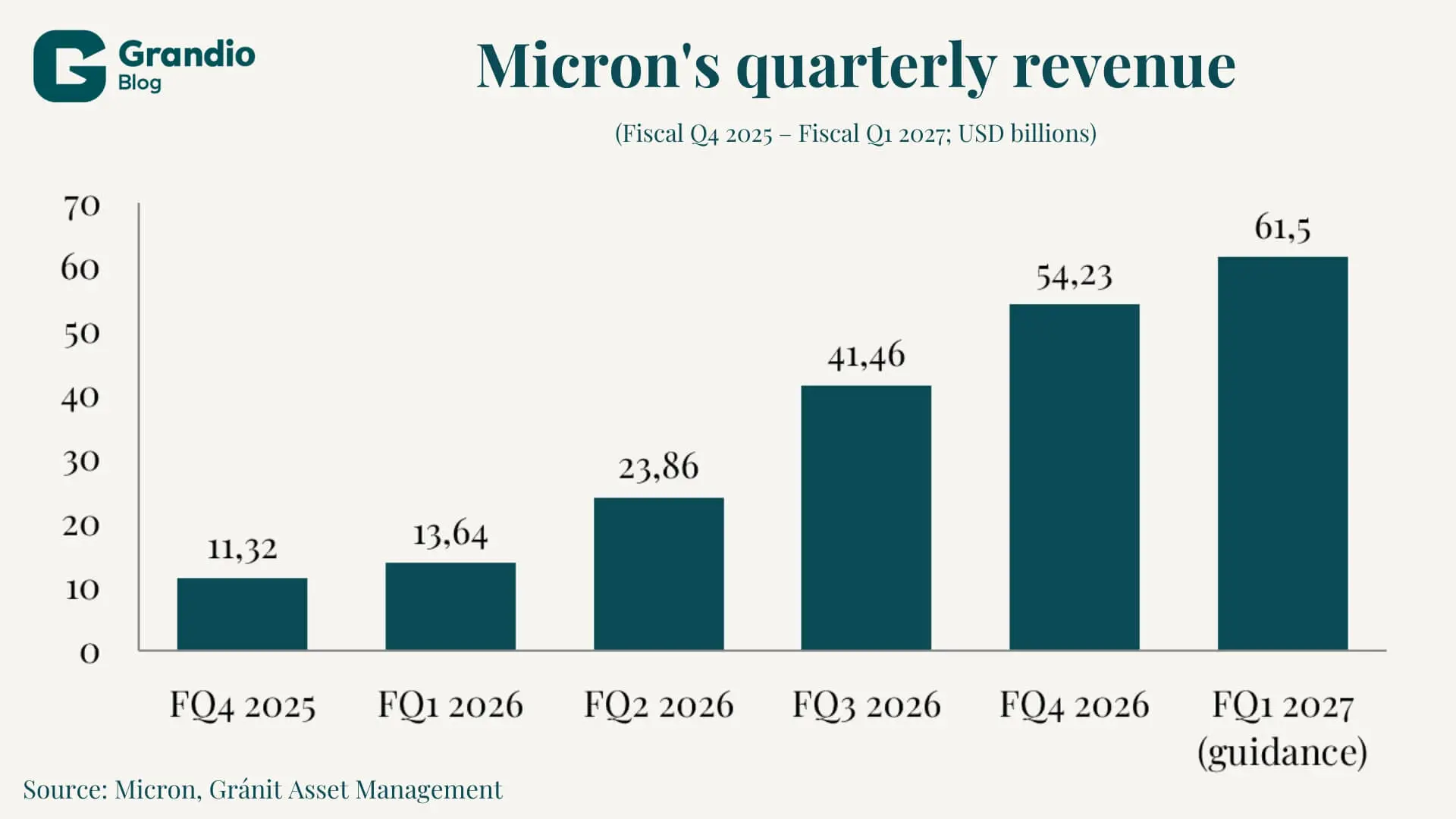
Micron’s quarterly revenue nearly quintupled in a year, from $11.32 billion to $54.23 billion, and the company expects $61.5 billion for the current quarter.
All Three Win, but Not Equally
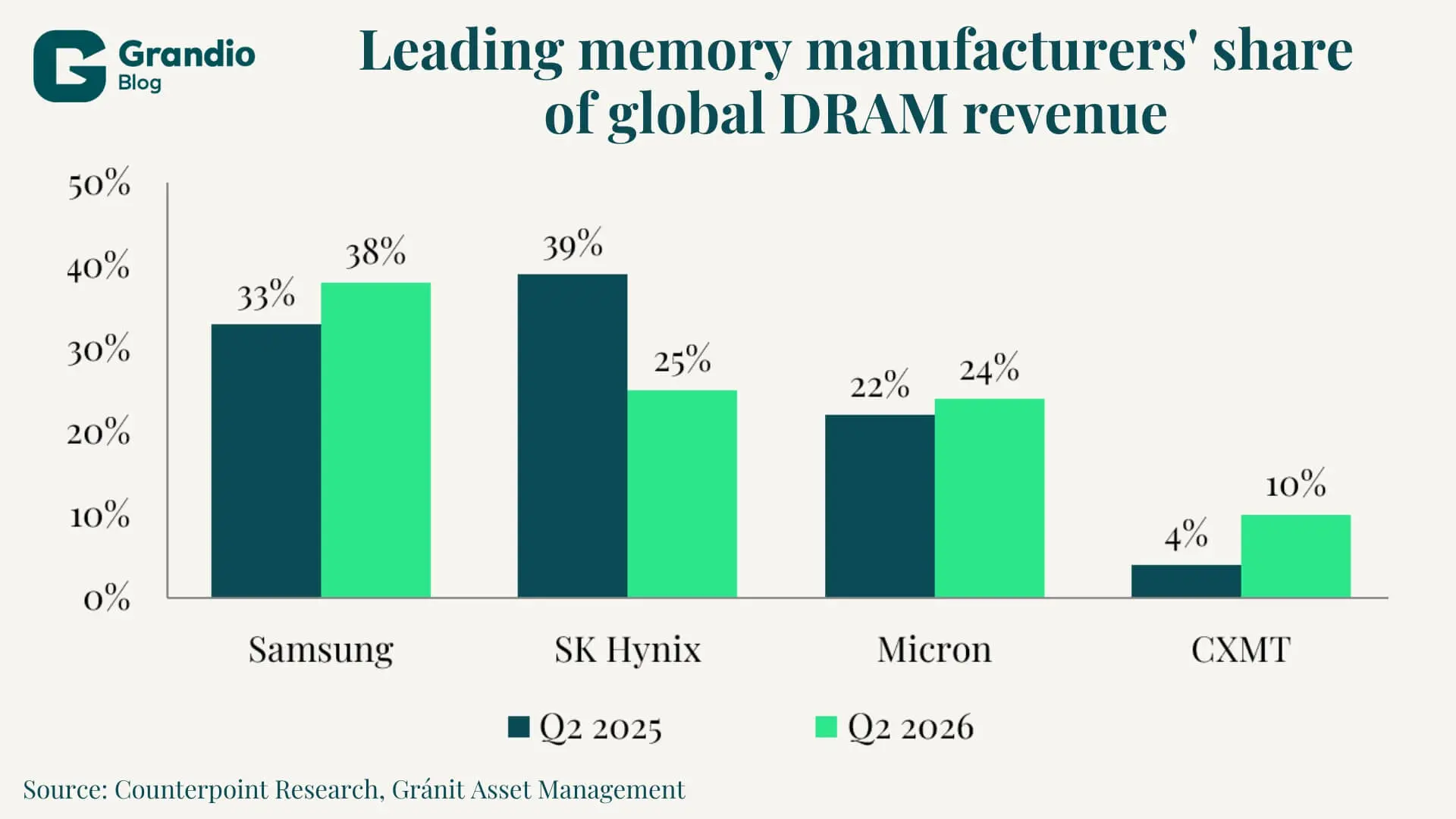
SK Hynix was the first to ride the HBM wave, and its second-quarter operating margin, reported in late July, came in at 76 percent. Even so, Blocks and Files, citing Reuters, reported that both revenue and operating profit missed analysts’ forecasts because the company had put so much of its DRAM capacity into HBM that it had little conventional DRAM to sell just as its price was climbing fastest. Counterpoint’s quarterly tracker, published in September, shows SK Hynix’s share of the overall DRAM market falling from 39 percent to 25 percent in a year. Its HBM share also slid, from 64 percent to 50 percent, as Samsung caught up.
Samsung’s HBM share jumped from 21 percent to 33 percent in a single quarter, according to Counterpoint, and Samsung took back first place in the overall DRAM market with 38 percent. Micron edged up from 22 percent to 24 percent in DRAM and holds 18 percent of HBM. DRAM market revenue in the second quarter was up 385 percent from a year earlier, so all three came out ahead, though SK Hynix captured less of the conventional DRAM price spike than it could have.
China Is Pushing Into Conventional DRAM
The threat to conventional DRAM comes from China. CXMT listed on 27 July on the STAR Market, the tech board of the Shanghai Stock Exchange, and its shares closed their first day at 49 yuan against an offer price of 8.66 yuan. That valued the company at roughly 3.3 trillion yuan, and the offering raised 57.92 billion yuan. Counterpoint puts CXMT’s DRAM market share at 10 percent, up from 4 percent a year earlier. The projects listed in its prospectus target DRAM technology and production lines, and none is dedicated to HBM. Still, The Investor, citing The Information, reported that CXMT is already making small volumes of HBM3E, the generation before HBM4.
For now, CXMT is the higher-cost producer. SemiAnalysis estimates that CXMT’s DDR5, the standard memory used in today’s PCs and servers, costs over 30 percent more per bit to produce than the big three’s. Retail DDR5 kits built on CXMT chips currently sell for the same price as big-brand kits, so China’s entry has not set off a price war yet. Analysts are split, as a Tom’s Hardware roundup shows. Nomura assumes CXMT’s share of global DRAM output will rise from about 10 percent to 18 percent by the end of 2028. Morningstar’s analysis, published on 28 July, by contrast, puts fair value at 16.10 yuan, less than a third of the first-day closing price of 49 yuan. It identifies CXMT’s lack of access to EUV lithography as a key constraint. EUV is the most advanced chipmaking lithography technology and is important for further shrinking DRAM chips.
Only 6.73 percent of the shares were freely tradable at the time of listing. However, the official listing document sets out different lock-up periods for different groups of shareholders. The first notable release is scheduled for 27 January 2027, when approximately 1.52 billion shares, representing 2.24 percent of the total share capital, may become eligible for sale. A much larger release is expected on 27 July 2027, when another 22.28 billion shares, or 32.82 percent of the total, could become tradable. Restrictions on a substantial portion of the shares will remain in place until July 2029. The expiry of a lock-up period does not, of course, mean that shareholders will necessarily sell their shares.
Two Scenarios and a Double-Edged Contract
If take-or-pay contracts, customer deposits and Nvidia’s multiyear commitments hold, memory makers can keep their margins high for years. Micron itself expects supply to be even tighter in 2027 and 2028 than this year. If Chinese capacity drives down prices for uncontracted conventional DRAM in 2027 and 2028, the big three will take the hit on the volume they have not locked in. Three signals will show which scenario plays out. The first is TrendForce’s quarterly price forecast, which projects a 10–15 percent quarter-on-quarter increase in conventional DRAM contract prices in the fourth quarter of 2026. The second is the gradual expiry of CXMT’s share lock-ups, particularly the substantial release scheduled for July 2027, together with the ramp-up of its Shanghai fab in 2027. The third is how much revenue the ceilings in Micron’s contracts cost it if the shortage gets worse.
The full third-quarter results published in late October provide further evidence. On 28 October, SK Hynix reported revenue of 104.6 trillion won and operating profit of 83.3 trillion won, equivalent to an operating margin of 80 percent. Samsung’s results, released the following day, also confirmed the memory market’s exceptionally strong performance.
Consumers in Hungary and elsewhere feel all of this in the prices of laptops and phones. TrendForce already expects notebook shipments to fall in 2027. Two of the big three trade in the US. Micron is listed there, and SK Hynix’s American depositary receipts have traded on the Nasdaq since July. For investors, HBM and volumes locked in under long-term contracts promise steadier revenue than past cycles delivered, while conventional DRAM is as cyclical as ever. The two deserve separate valuations. These contracts cut both ways, since the same agreement that sets a price floor also caps the upside when prices keep rising.
Legal Disclaimer
This document has been prepared by Gránit Alapkezelő Zrt. (registered office: 1134 Budapest, Váci út 17; company registration number: 01-10-046307) for marketing and informational purposes. Accordingly, it has not been produced in accordance with legal requirements designed to promote the independence of investment research. Nor is it subject to any prohibition on dealing ahead of the dissemination of investment research. This document does not constitute investment research or investment advice. Any data presented refers to past performance, and past performance is not a reliable indicator of future results. Each investor must make investment decisions at their own discretion and responsibility.