
On 12 June 2026, the day SpaceX went public, Elon Musk became the world’s first trillionaire, at least on paper. Seven weeks later, the Bloomberg index estimated his fortune at just USD 684 billion. More than USD 600 billion had seemingly vanished, even though Musk had not sold a single share.
The episode shows what billionaire lists actually measure: what a person’s holdings would be worth on a given day, priced at the last stock market quote or at an estimated multiple. That is a useful number, but it is not the same as the amount of money the owner can actually use.
A record year for the lists
The 40th edition of Forbes’ annual billionaires list features a record 3,428 billionaires with a combined net worth of USD 20.1 trillion, USD 4 trillion more than a year earlier. This is broadly comparable in magnitude to China’s annual GDP, although it compares a stock of wealth with an annual flow of economic output. Concentration is high as well: the 20 people worth more than USD 100 billion each hold USD 3.8 trillion between them, so half a per cent of billionaires own close to a fifth of all billionaire wealth.
The uncertainty in these figures becomes visible when Forbes is compared with other data providers:
| Source | Reference date | Number of billionaires | Total wealth (USD trillion) |
| Forbes World’s Billionaires 2026 | Prices as of 1 March 2026 | 3,428 | 20.1 |
| Altrata Billionaire Census 2026 | End of 2025 | 3,795 | 15.1 |
| UBS Billionaire Ambitions 2025 | 2025 | 2,919 | 15.8 |
Source: Forbes (Business Wire), Altrata (Aletihad), UBS (Scheerpost).
Part of the gap comes from timing, as AI stocks pushed top fortunes even higher in the first months of 2026. The larger part, however, is methodological: the providers treat family fortunes differently, value private companies differently and count different items as debt. The gap between the highest and lowest counts is almost 900 people, which shows clearly that “billionaire” is an estimated category.
What does a billionaire actually own?
The popular image equates wealth with yachts, private jets and beachfront villas, yet these make up the smallest part of it. According to Altrata’s 2026 billionaire census, the average billionaire holds 38% of their wealth in stakes in listed companies, 34.5% in private companies, 25.8% in liquid assets and only 1.7% in real estate and luxury goods. The last category covers homes, art, jewellery, wine, cars, yachts, private jets and even sports teams.
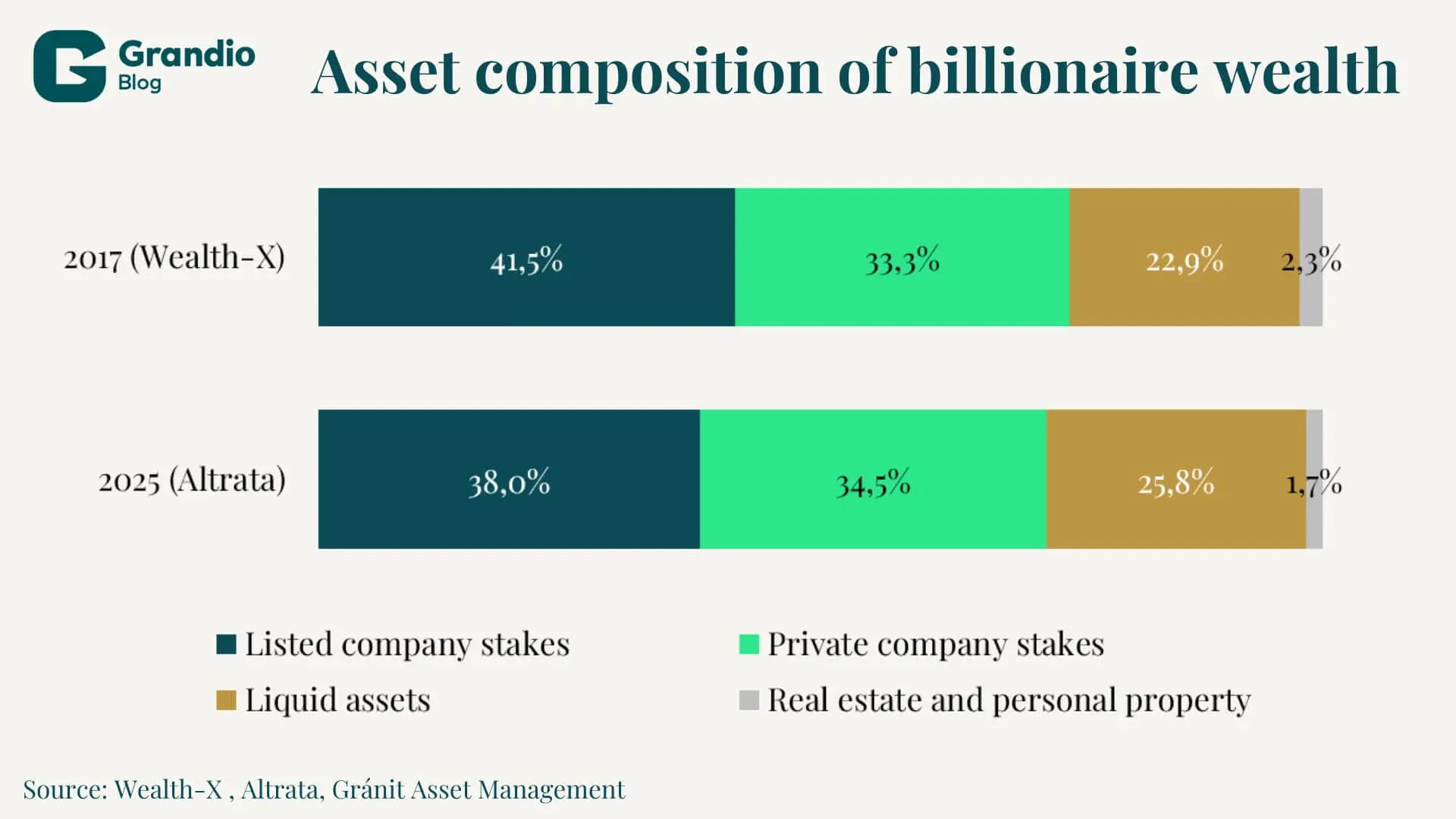
The proportions have barely changed over the years: in 2017 the four figures were 41.5, 33.3, 22.9 and 2.3%. This, of course, does not mean that billionaires live modestly. Roughly 15% of them own a private jet, and on average they own more than 3.5 homes. Compared with a fortune of USD 4 billion, however, a USD 100 million mansion or a USD 60 million aircraft is a small item.
At first sight the 25.8% liquid share looks substantial, roughly USD 1 billion per person on average. The average, however, hides the top of the list, where fortunes sit almost entirely in a single company: Larry Ellison’s mainly in Oracle shares, Musk’s in SpaceX and Tesla. Among younger billionaires the share of listed holdings is even higher, 63% for those under 50 and around 40% for older ones.
Share price and saleability
The lists value listed holdings by multiplying the number of shares by the last share price. For a retail investor’s few hundred shares this gives an accurate result, but not for a founder’s 40% stake. If the owner started selling, the mere news of the intention would put the share price under pressure.
The SpaceX listing illustrates this well. The company raised USD 75 billion at USD 135 per share, which valued it at USD 1.77 trillion. At the same time, only 3–4% of the shares were in free float, the founder is subject to a one-year lock-up, and the company traded at 93 times its annual revenue. Musk’s fortune was therefore set by the daily price of a small fraction of the company, in both directions.
Valuations play an even greater role in the case of privately held companies. For example, reports of a fundraising round being prepared by Blue Origin in 2026 referred to a company valuation of USD 130 billion. Such a valuation can directly affect the owner’s estimated net worth, even without an actual sale of shares. For most private companies, Bloomberg applies a liquidity discount of only 5%.
Musk’s 2022 purchase of Twitter showed what happens when a billionaire actually needs cash. He sold close to USD 23 billion of Tesla shares, and even speculation about further sales weighed on Tesla’s share price. A fortune of this size cannot be withdrawn like a bank deposit: the list shows the estimated value of a controlling stake rather than money that can be spent.
The other side of the balance sheet
Because selling is expensive, owners of large fortunes prefer to borrow against their shares. This way they keep their voting rights, do not depress their own share price and do not realise a taxable capital gain. The debt, however, remains, and it typically appears only partly in the net worth shown by the rankings.
Larry Ellison’s case is the best documented. According to Oracle’s 2025 proxy statement, he had pledged 346 million shares, 30% of his stake, as collateral for personal loans. In 2018 Oracle banned its directors from pledging shares, but Ellison was granted an exemption. Neither the size of the loans nor the loan-to-value ratio has been disclosed.
In December 2025, Ellison gave an irrevocable personal guarantee for USD 40.4 billion of the equity in Paramount’s offer for Warner Bros. Discovery. At the time this looked like a show of financial strength. By the end of July 2026, however, Oracle’s share price had fallen from its peak of USD 345.72 to around USD 120, a drop of about 65%.
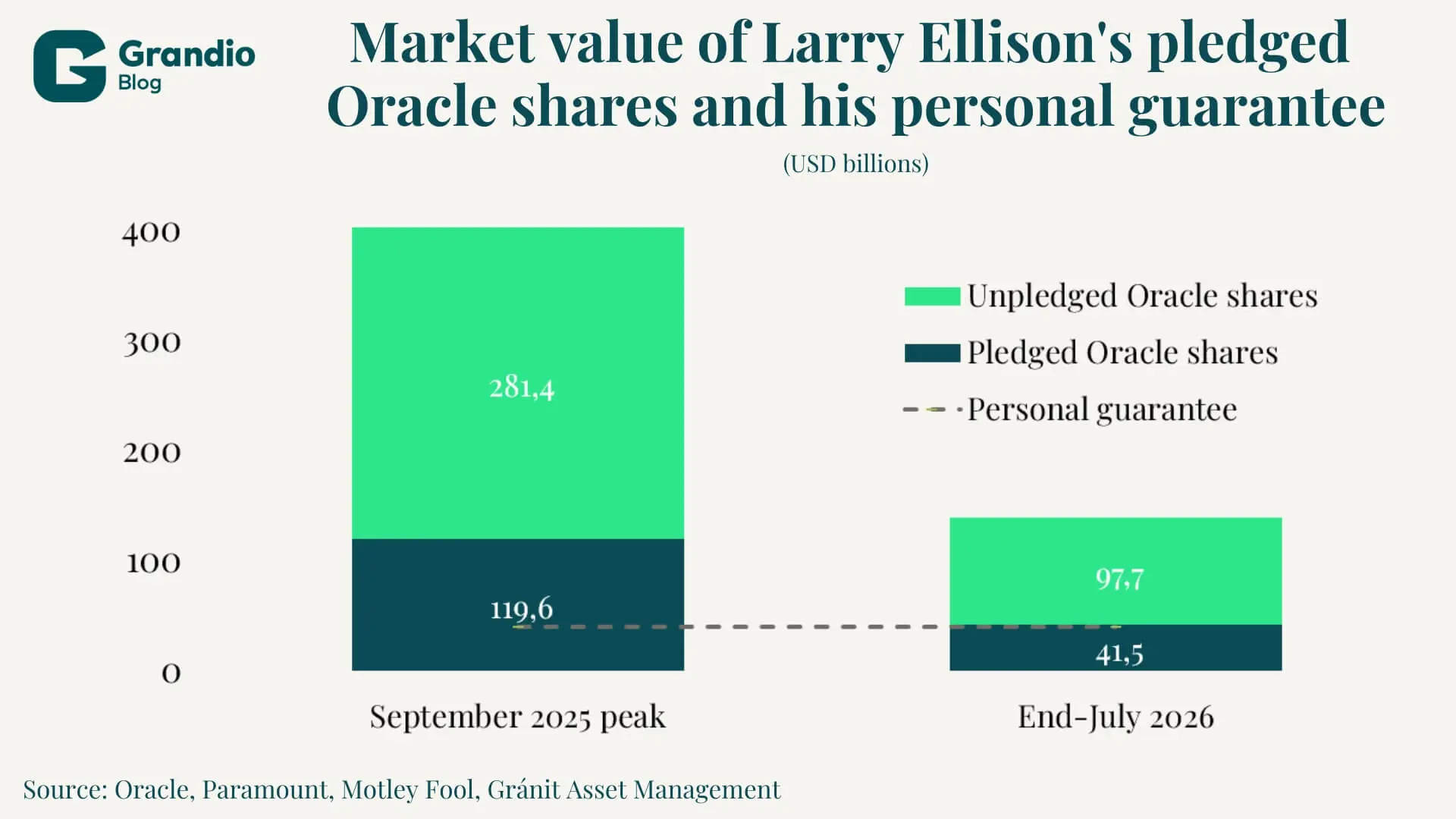
The amount of the guarantee remained unchanged, while the market value of the pledged Oracle shares, calculated using the 2025 pledged share count, had fallen to around USD 41.5 billion by the end of July. This was broadly comparable to the guarantee, but the two amounts represent separate financial obligations. The deal closed in October, backed by USD 47 billion of new equity and a USD 57.5 billion bank financing commitment. It is not public whether Ellison is funding his share by selling stock or by taking on more debt. On 1 October, Forbes estimated his fortune at USD 179 billion, less than half of his 2025 peak.
According to Oracle’s September 2026 filing, Ellison had pledged approximately 413 million shares as collateral for personal loans, compared with 346 million a year earlier. Separately, his USD 40.4 billion personal guarantee in connection with the Paramount–Warner Bros. Discovery transaction related to the equity-financed portion of the deal. Public disclosures do not establish that the two obligations were backed by the same pledged shares.
Ellison is not an exception. According to Tesla’s disclosures as of the end of September 2026, Elon Musk had pledged approximately 207.5 million Tesla shares as collateral for personal loans, while Peter Thiel had pledged more than USD 1 billion worth of Palantir shares.
A simple example
Take two investors. “A” holds USD 10 billion of shares and has no debt. “B” holds USD 20 billion of shares and has USD 10 billion of loans. According to the list, both are worth USD 10 billion.
If the share price falls by 30%, A’s wealth drops to USD 7 billion, while B’s falls to USD 4 billion (14 − 10), twice the loss. At that point the bank asks for additional collateral or sells the pledged shares, which pushes the share price down further. Leverage therefore mainly increases the vulnerability of a fortune, and this cannot be read from the rankings.
Buy, borrow, die
The US tax system actively favours this practice. The essence of the “buy, borrow, die” strategy is that the owner holds on to the appreciating asset and borrows against it; the loan does not count as income and is therefore not taxed. Finally, the asset passes to the heirs, who generally receive a step-up in its tax basis to its fair market value at death, potentially eliminating capital gains tax on the appreciation accumulated during the original owner’s lifetime.
In 2021, using leaked tax data, ProPublica calculated that between 2014 and 2018 the 25 richest Americans paid only 3.4% of the growth in their wealth in federal income tax. Its critics argue that the measure is misleading, because unrealised capital gains are not income. The method of calculation is open to debate, but the mechanism is real: owners of large fortunes finance their living costs and investments largely with borrowed money.
What does Forbes see, and what does it miss?
Forbes does not ignore debt. Where possible, its reporters consult the billionaires themselves, and known debt is deducted. Bloomberg treats pledged shares separately: under its methodology, it deducts either the value of the pledged shares or the debt secured by them from its wealth estimate, while assets demonstrably acquired with the borrowed funds may still be taken into account.
The key point, however, is that only known debt is deducted. According to Bloomberg’s methodology, no assumptions are made about personal debt, so whatever is not public is not deducted. A private bank credit line, a loan within the family or debt taken on at holding company level typically does not appear in any stock exchange filing. A guarantee does not even count as debt until it is called.
Individual methodological choices can lead to large differences:
In July 2025, Bloomberg changed how it accounts for Ellison’s pledged shares, and as a result his fortune rose by about USD 33 billion in a single day.
Forbes leaves USD 102 billion of not yet vested Tesla shares out of Musk’s fortune.
Bill Gates dropped out of the Forbes top ten in 2024 because the magazine obtained new information that significantly reduced its estimate of his fortune.
Royal families, whose wealth is tied to their position, are excluded from the list altogether.
The ranking is therefore a careful estimate that handles public data well but treats non-public data as zero. Hidden debt can make it overstate wealth, hidden assets can make it understate it, and which effect is stronger differs from person to person.
What the number does not tell you
The observation that large fortunes consist mainly of company stakes rather than cash, and that debt is not visible, is essentially correct. A few further points, however, add nuance to the picture:
The lists deduct only publicly known debt; guarantees and the degree of leverage do not appear in them.
The list shows pre-tax value. A US founder selling their shares would pay 23.8% federal tax on the capital gain, and in many states state tax on top of that. With a cost basis close to zero, this can take up to a quarter of the “wealth”.
A 40% stake cannot be sold at the quoted price; the realistic discount is far larger than the few per cent applied in the lists.
A large fortune means control above all. Even after the listing, Musk holds more than 82% of the voting rights in SpaceX. One of the main reasons for pledging shares is precisely to keep control.
The value of a fortune concentrated in a single stock can move by 30–40% within weeks. Between March and October, seven places in the top ten changed.
The rankings do not even agree with each other: for roughly the same period they show between 2,919 and 3,795 billionaires and a difference in total wealth of about USD 5 trillion.
Large fortunes in Hungary
In Hungary, most substantial private fortunes were built after the transition to a market economy, largely through the appreciation of businesses and ownership stakes. Compared with multigenerational family wealth in Western Europe, Hungarian fortunes therefore tend to be younger and often more concentrated. Much of this wealth is tied up in unlisted businesses whose assets may include machinery, property and land, leaving relatively limited readily available cash.
Fortunes barely forty years old
The nationalisations of 1948–1949 fundamentally reshaped private ownership in Hungary, while post-transition privatisation played a decisive role in the formation of many of today’s largest fortunes. Spontaneous privatisation took place between 1987 and 1990, and state-directed privatisation between 1990 and 1998. The process was set in motion by the 1988 Companies Act, which allowed state enterprises to be converted into business companies.
The indebted country sold mainly for cash, largely to foreign strategic investors: assets worth HUF 310 billion between 1990 and May 1994. Separate schemes were set up for domestic buyers: the subsidised Existence Loan (E-loan), compensation vouchers, payment by instalments, the employee share ownership programme (MRP) and management buyouts (MBO). The MRP offered even more favourable financing than the E-loan, and most such deals took place in 1994.
A large part of Hungary’s ownership class thus acquired its companies with little capital of their own, with subsidised loans and from management positions, so leverage has been present in Hungarian fortunes from the very beginning. According to a 2018 Opten survey, most leaders of companies founded in the 1990s had already reached retirement age by then, so the first large generational transfer of these fortunes is happening now.
Regional comparison
The origin of wealth also differs clearly by geography. Moving east and south, first-generation wealth created through privatisation is typical; in the west, family company wealth inherited over several generations.
| Country / region | Typical origin of large fortunes | Example |
| Former Yugoslav states | Privatisation in the 1990s, often followed by debt-financed expansion | Croatia’s Agrokor: from a flower nursery to a group worth 15% of GDP, then collapse under about USD 7 billion of debt |
| Czech Republic | Voucher privatisation through investment funds | PPF started in 1991 as a privatisation fund and went on to own the largest Czech insurer |
| Hungary | Cash privatisation alongside MBO, MRP and E-loans | 21 of the 2002 top 100 are still in the top hundred today |
| Germany, Austria | Family companies inherited over generations | Only about a quarter of German billionaires are self-made |
Source: Fox News/AP (Agrokor), Wikipedia (PPF), 444 (top 100), Business Punk (Germany).
The case of Croatia’s Agrokor illustrates the above well. The company bought state enterprises during the privatisation of the 1990s, then in 2014 acquired a majority stake in Slovenia’s Mercator with expensive debt. The group, large on paper and employing 60,000 people, eventually collapsed under its debt, and the Croatian state took over its management through a special law. The rankings showed the asset side, but the risk was on the liability side.
The situation is different in Western Europe. The value of a German family company often goes back a century or more, ownership is spread across several family branches, foundations and holdings, and it rarely changes hands. In this respect Hungary is closer to the eastern pattern: its fortunes are young, concentrated and in many cases still in the hands of the founder.
What are Hungarian fortunes made of?
According to the central bank’s (MNB) wealth survey, at the end of 2020 the top tenth of households held 48.5% of net wealth. In this group, cash and bank deposits made up only 9% of gross assets, while shares, equity stakes and debt securities accounted for 38.6%. About 80% of all shares and equity stakes are held by the top tenth.
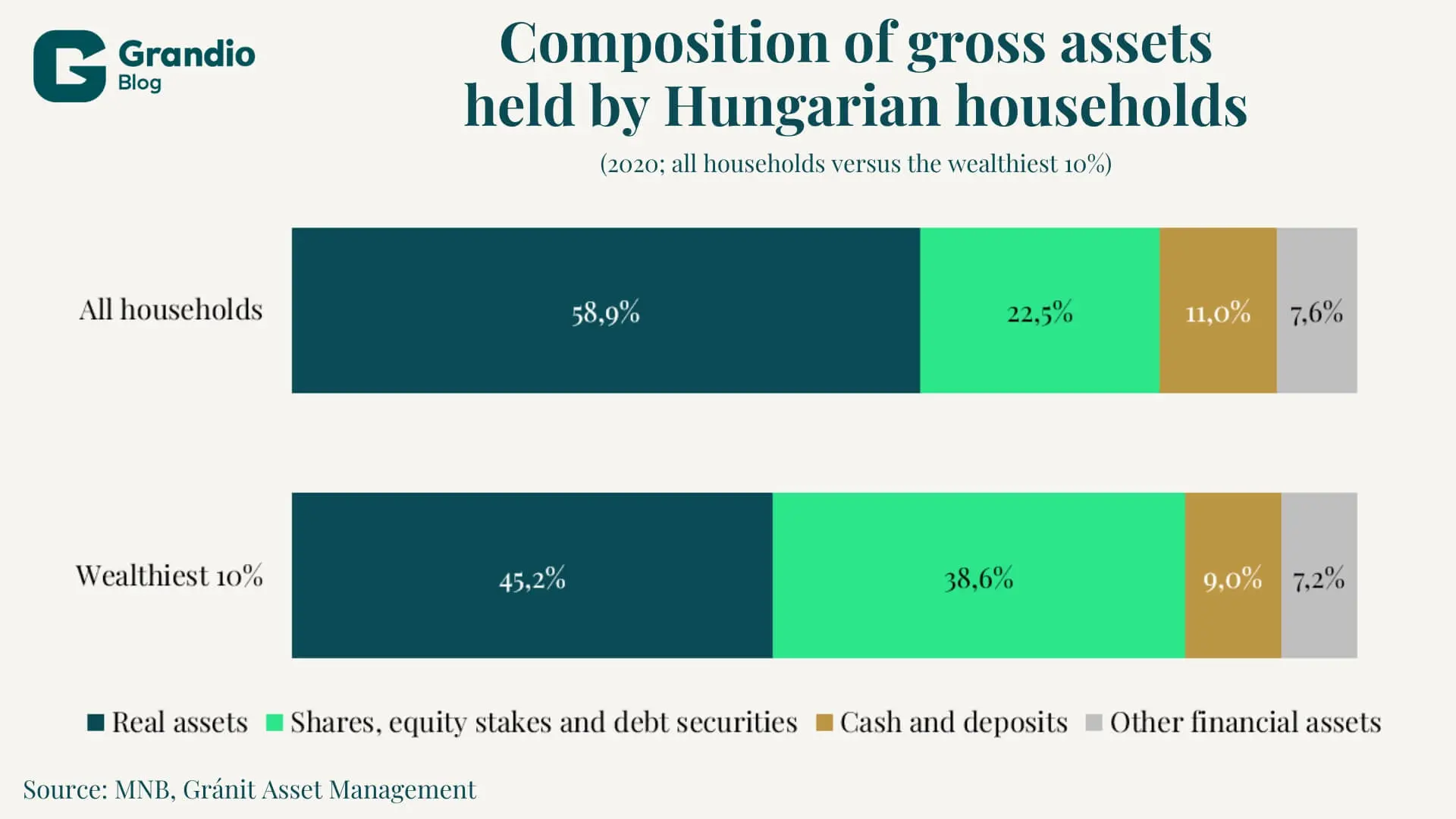
More recent data paint a similar picture. According to the MNB’s 2026 savings report, the top 10% hold 71% of household financial wealth, and in 2025 most of the revaluation came from the rising value of household-owned businesses.
Two figures illustrate the gap between company wealth and liquid wealth well. The Joint Venture Association estimates that about 6,400 individuals hold company wealth above HUF 1 billion, worth around HUF 30,000 billion in total, and according to the association a large part of it is not backed by sufficient liquid funds. Private banks, by contrast, manage just over HUF 12,000 billion, on average close to HUF 190 million per account. Only a small part of this is cash: about 5% of portfolios at one provider.
Investment and depreciation
A large part of Hungarian wealth is held in machinery and real estate. Over the past decade Hungary achieved one of the highest investment rates in the EU, 27.5% of GDP in 2020, with an exceptionally high share of construction. In agriculture, a record of more than HUF 300 billion of machinery and parts changed hands in 2021, and sales of new machines depend heavily on the availability of subsidies.
A tractor, a hotel or a logistics warehouse depreciates year after year and eventually has to be replaced. On the balance sheet it still counts as wealth, and the value it is given depends on the methodology. Forbes values Hungarian production companies on the basis of EBITDA, and real estate and asset management companies on the basis of their assets. EBITDA is earnings before depreciation, so the value of an asset-heavy company calculated with a multiple can be far higher than the cash it actually generates after replacement investment.
What does the Hungarian ranking measure?
In the first edition of “The 100 Richest Hungarians” in 2002, HUF 2.5 billion was enough to make the list. In 2026 the threshold was HUF 20 billion, and the combined wealth of the hundred richest people was HUF 12,579 billion, 14% more than a year earlier.
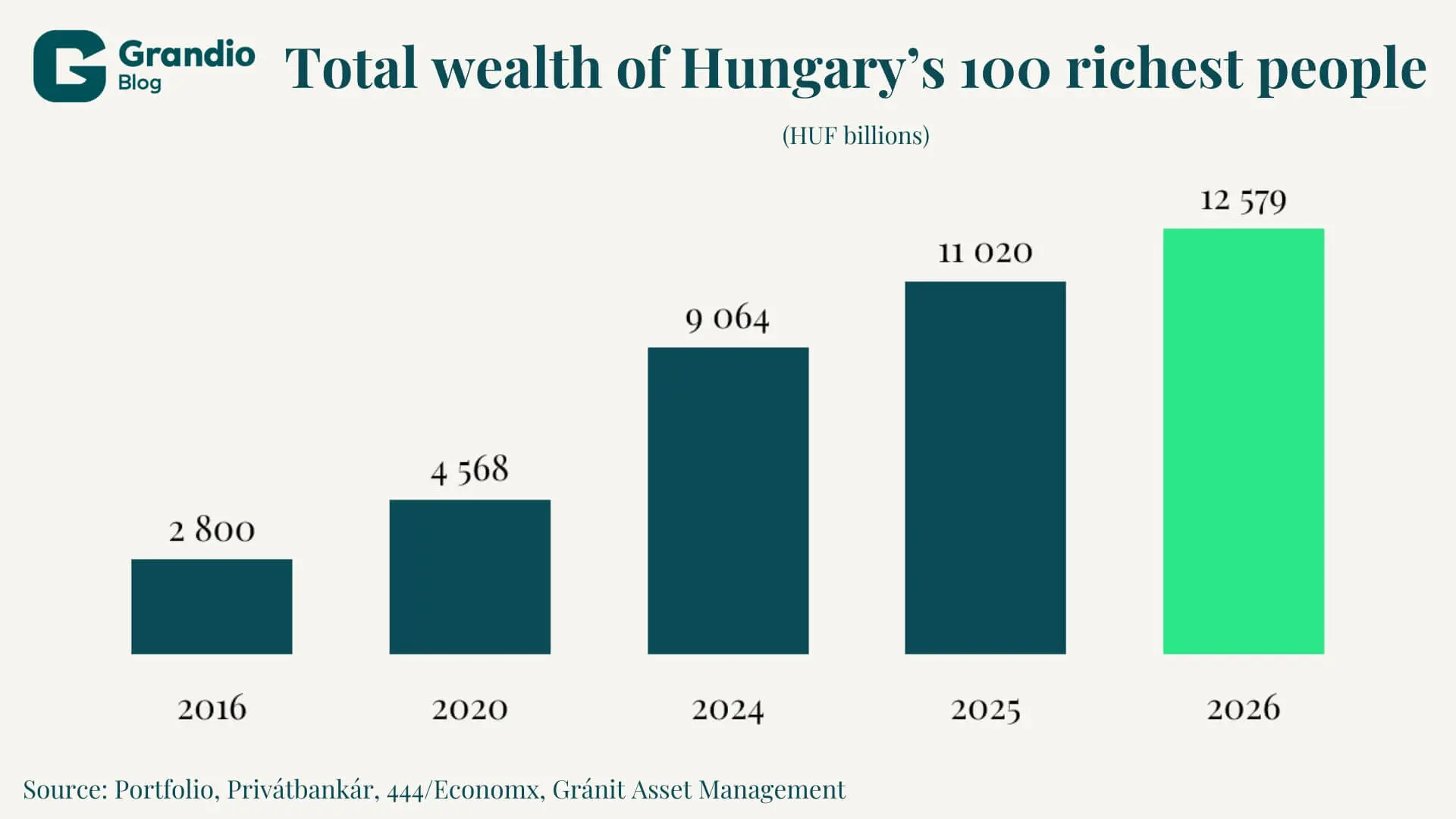
Concentration is high here as well: the top ten hold 46% of the hundred’s wealth. The Hungarian list also follows changes more slowly than the international ones, because it is based not on daily share prices but on company accounts published a year later.
Conclusion
Billionaire lists measure what a person’s holdings would be worth on a given day, after deducting known debt. That is a useful reference point, but it is not the same as savings or spendable money, and it says little about risk.
To understand large fortunes, it is worth looking at the structure of the balance sheet rather than the net total: how concentrated the wealth is in one company, how large the liquid share is, how much is pledged or guaranteed, and how much tax an actual sale would trigger. Seen this way, Musk’s USD 936 billion is a block of shares that is hard to move, and a significant part of Ellison’s USD 179 billion already serves as collateral for loans.
In Hungary all of this is even more true. Large fortunes tend to be relatively young and are often held in unlisted businesses, machinery and property, while cash accounts for a small share even among the wealthiest. The wealth of the richest is embodied mainly in ownership, and their liquidity is often provided by loans taken out against that ownership.
Legal Disclaimer
This document has been prepared by Gránit Alapkezelő Zrt. (registered office: 1134 Budapest, Váci út 17; company registration number: 01-10-046307) for marketing and informational purposes. Accordingly, it has not been produced in accordance with legal requirements designed to promote the independence of investment research. Nor is it subject to any prohibition on dealing ahead of the dissemination of investment research. This document does not constitute investment research or investment advice. Any data presented refers to past performance, and past performance is not a reliable indicator of future results. Each investor must make investment decisions at their own discretion and responsibility.