
On August 26, Nvidia reported $96.2 billion in quarterly revenue, more than double the year-earlier figure, and guided the current quarter above Wall Street’s estimates. A day later, S&P Global Ratings said the six largest hyperscalers, the companies that run the world’s biggest clouds and data centers, will all post negative free operating cash flow in 2026 and 2027. The two headlines are the same money seen from opposite sides of the ledger. What Nvidia books as revenue, its customers book as capital spending, and they are covering more and more of it with debt, leases and fresh equity. So the real question is not whether the business is good. It is who is paying for it, and for how long.
Companies rarely beat on every line that matters and then guide the next quarter above consensus. It is rarer still for the conversation afterwards to be about financing. Yet that is exactly what happened with Nvidia’s second quarter, because behind the numbers sits one simple question: where will customers find the next trillion dollars for chips and data centers? Credit analysts got there first, because the world’s largest technology companies are, for the first time, spending more on infrastructure than their operations generate.
A Record the Market Did Not Want to Believe
Heading into the report, Nvidia had fallen for seven sessions in a row, its longest losing streak since 2022, as Yahoo Finance noted on August 25. The stock was up only about 12 percent for the year, while the Philadelphia Semiconductor Index had climbed roughly 61 percent. The market was not worried about bad numbers. It was worried that even good numbers would no longer be enough.
Against that backdrop, second-quarter revenue of $96.2 billion came in 18 percent above the prior quarter and 106 percent above a year earlier, with gross margin at 75.0 percent on both a GAAP and non-GAAP basis. Data center revenue climbed to $89.0 billion, up 117 percent from a year ago and accounting for 92 percent of the total.
For the third quarter, the company guided to $108 billion, plus or minus 2 percent, against a consensus of $104.2 billion. On the earnings call, CFO Colette Kress went further, pointing to roughly 70 percent revenue growth in fiscal 2028 and calling that a supply-constrained outlook: supply sets the ceiling, not demand. And all of this excludes China, since the guidance assumes no Chinese data center revenue at all. The stock jumped 8.7 percent the next day and closed September 11 up roughly 17 percent year to date.
Who Picks Up the Tab?
What is revenue for Nvidia is capital spending for its customers. That is where the August 27 note from S&P Global Ratings comes in.
The rating agency covers six companies: Alphabet, Amazon, Microsoft, Meta, Oracle and SpaceX, which has counted as a hyperscaler in its own right since its June IPO, with xAI folded in. S&P expects the six to spend more than $1.3 trillion on capex in 2027 and sees free operating cash flow staying negative at every one of them in 2026 and 2027, with no return to positive territory likely before 2029. A summary of the report puts the group at $470 billion in 2025 and $870 billion this year, while a second S&P report in early September tallies more than $7 trillion of investment between 2025 and 2030.
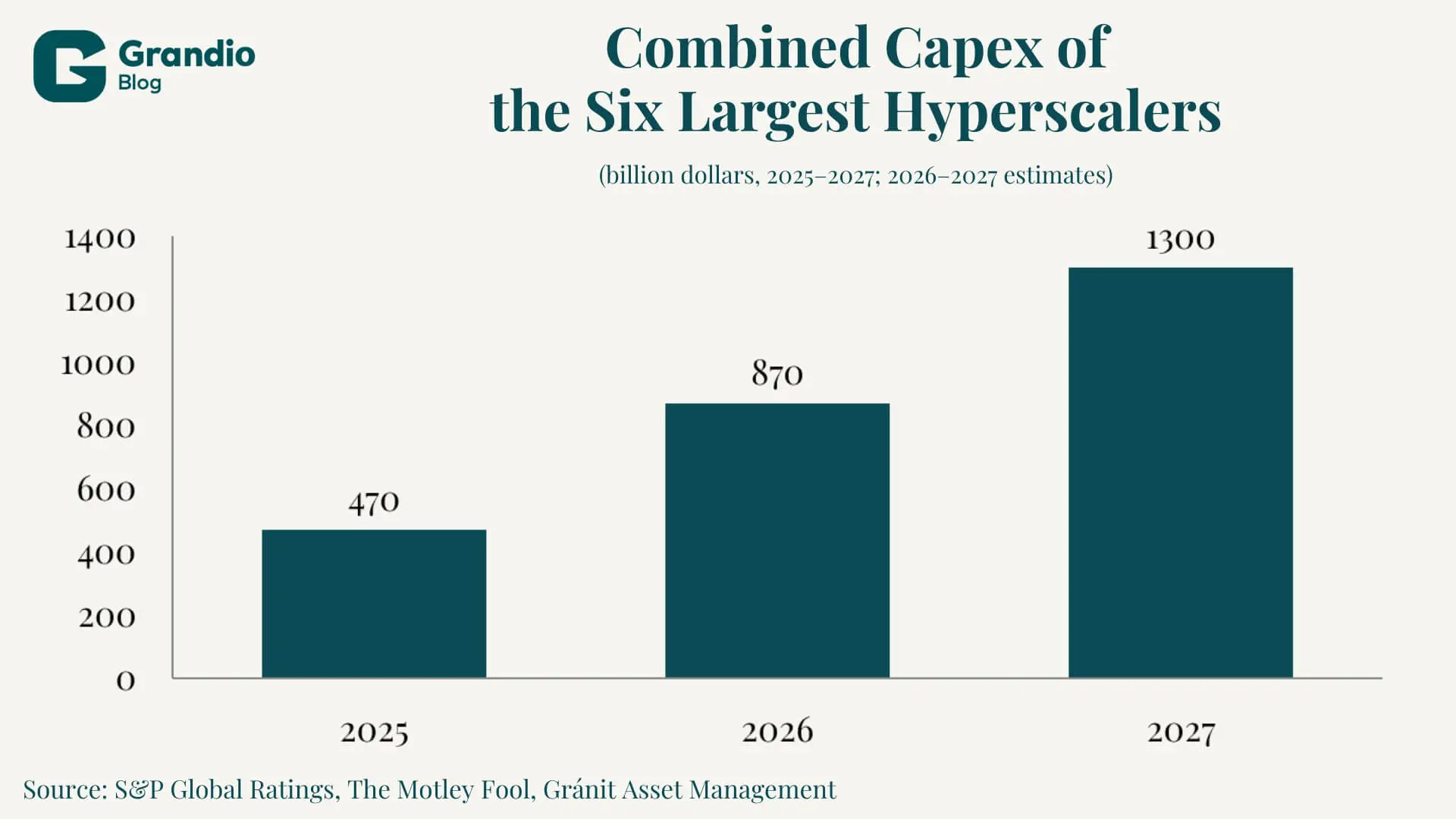
There are two different $1.3 trillion figures in circulation. On the call, Kress was talking about the five largest hyperscalers, whose capex would climb from nearly $800 billion this year to $1.3 trillion in 2027. S&P counts six companies and starts from $870 billion. The 2027 endpoint is nearly identical, but the group of companies is not, so this piece sticks with S&P’s six throughout.
The S&P note says debt, equity issuance, leases, joint ventures, special purpose vehicles and residual value guarantees are all playing a bigger role. A special purpose vehicle is a stand-alone entity created to hold a data center and its debt off the parent’s balance sheet. A residual value guarantee is a commitment that someone will buy the chips at a pre-agreed price when the term ends.
Credit strategists at Goldman Sachs estimate that roughly a third of hyperscaler capex is being funded with debt this year and that the share peaks at 35 percent in 2027. That works out to about $400 billion of bond issuance against $1.14 trillion of capex.
Alphabet’s July results made this concrete. Second-quarter capex of $44.9 billion exceeded operating cash flow of $39.1 billion, pushing free cash flow to negative $5.9 billion, the first negative quarter since the company’s 2004 IPO. In the same quarter, Alphabet raised $49.6 billion in stock offerings and another $20.3 billion in notes.
The Fastest-Growing Customers Have the Least Cash of Their Own
Since this spring, Nvidia has broken out its data center revenue by two customer groups. Hyperscale covers the big public clouds and the largest consumer internet companies. ACIE, short for AI clouds, industrial and enterprise, covers the neoclouds that rent out GPU capacity, government-backed sovereign AI programmes, AI-native companies and enterprises running their own hardware.
According to the CFO commentary, hyperscale customers brought in $48.7 billion in the second quarter, up 13 percent from the prior quarter. ACIE customers brought in $40.3 billion, up 25 percent sequentially and 138 percent from a year earlier. On the call, management added that ACIE will drive most of the third-quarter growth, while the sovereign AI business, which runs largely through regional neoclouds, more than tripled year over year.
Longer time series call for some caution because, during the second quarter, Nvidia moved one company from ACIE to hyperscale and recast prior periods accordingly.
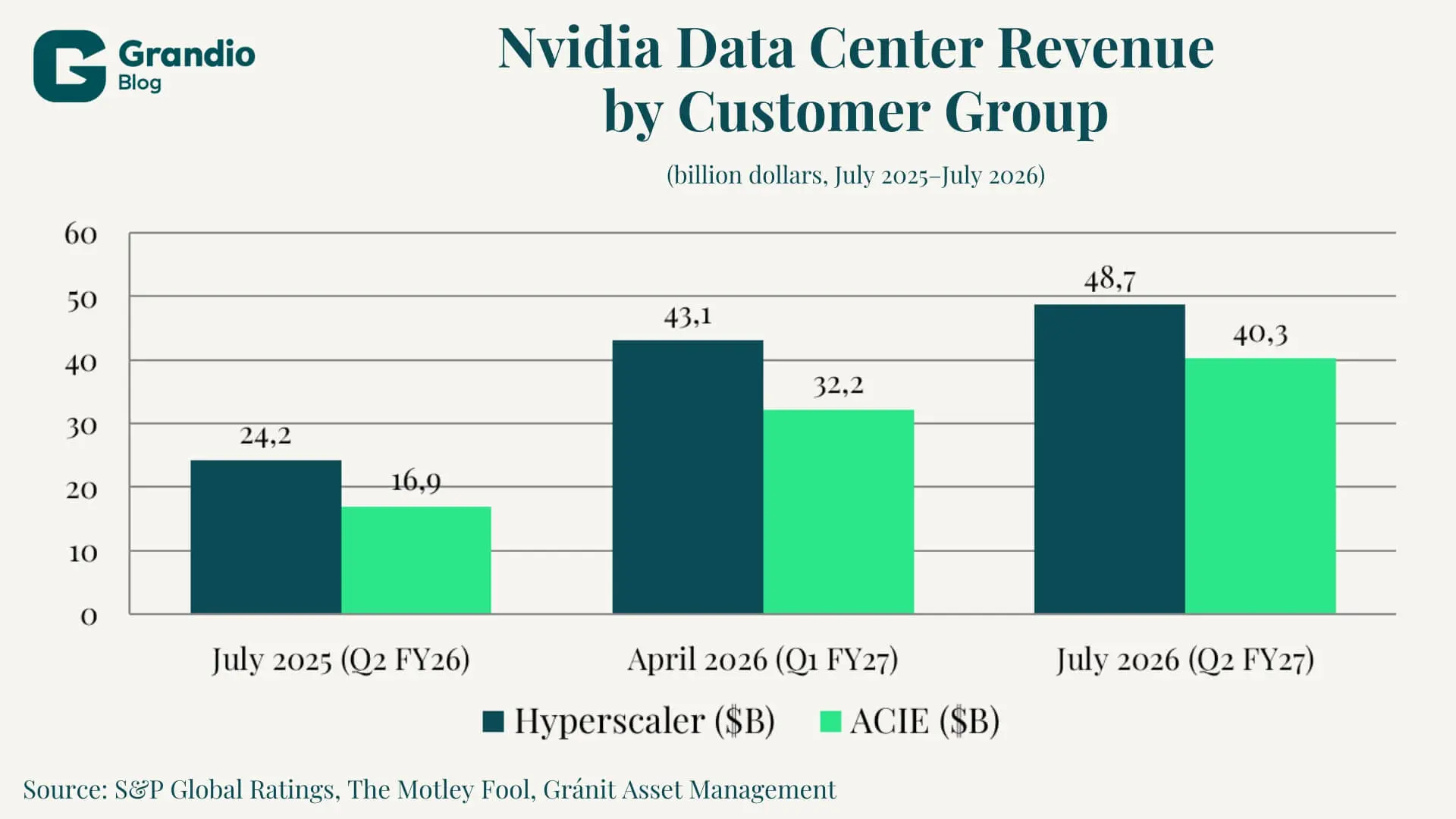
The split matters for financing because the fast-growing neoclouds and AI-native companies within ACIE typically lack the kind of stable, cash-generating core business that Alphabet has in search or Microsoft in software. A neocloud rents out a GPU fleet bought with borrowed money and pays down the loans from rental income. A sovereign programme lives off a government budget, and an AI-native company lives from one funding round to the next. Nvidia itself noted that many AI clouds and model developers are growing faster than their balance sheets and long-term credit profiles can support.
When Nvidia Becomes Its Customers’ Banker
Circular financing, where a supplier invests in a customer that then turns around and buys the supplier’s products, has been one of the most contested questions around Nvidia over the past year. Bank of America estimated in August that the company has committed roughly $70 billion in direct equity across its ecosystem, including $30 billion in OpenAI, up to $10 billion in Anthropic and $5 billion in Safe Superintelligence.
On the balance sheet, holdings in private companies, reported as non-marketable securities, grew from $22.3 billion in January to $51.2 billion in July, with another $18 billion in committed investments still to be funded this fiscal year. Add to that the $12.9 billion acquisition of Hugging Face, which the September 2 filing expects to close in the first half of 2027.
Two points complicate that picture. Jensen Huang said as far back as March that the $30 billion OpenAI investment and the $10 billion Anthropic investment were probably the last checks of that size, since both companies are heading for the public markets. The OpenAI commitment once billed at $100 billion has also shrunk to $30 billion. Gains on equity holdings fell from $15.9 billion to $7.8 billion in a single quarter.
At the same time, the company is increasingly guaranteeing rather than investing. In August, for example, it agreed to provide up to $105 billion in credit support for the buildout of SB Energy’s Ohio campus, whose capacity OpenAI will lease for 20 years. The guarantee only has to be honoured if OpenAI fails to pay.
The same month, Nvidia announced financing platforms with six major financial investors, from Apollo to KKR, designed to mobilise more than $500 billion in third-party capital for its customers over time. In other words, the company is now putting other people’s money behind its customers as well.
Meanwhile, Nvidia itself tapped the bond market, issuing $25 billion of notes during the quarter, and its long-term debt has risen from $7.5 billion in January to $32.4 billion. At the same time, it returned $26 billion to shareholders, $20 billion of it through buybacks. Purchase commitments to suppliers jumped from $119 billion to $279 billion in a single quarter.
A company generating $21 billion of free cash flow every quarter does not need to borrow. The fact that it does anyway says a lot about how much capital the supply chain, the guarantees behind its own customers and shareholder payouts are tying up all at once.
Two Years for Revenue to Catch Up With the Debt
S&P’s models put the inflection point in 2028, when revenue growth accelerates and capex growth slows, while Goldman sees the debt-funded share of capex peaking as early as 2027. The next two years therefore come down to whether the revenue actually coming in from AI services catches up with the cost of financing it.
The bullish case is that Google Cloud grew 82 percent in the second quarter, the cloud providers’ contracted but not yet recognised backlog tops $2 trillion by Kress’s account, and supply stays constrained through fiscal 2028. I wrote about the supply side, power and grid, earlier.
The risk is that debt on a data center built with borrowed money has to be serviced whether or not the tenant pays, and the rating agencies are saying that headroom on these balance sheets is shrinking fast.
Three signals will flag the turn early. The first is the ratio of bond issuance to capex. If the hyperscalers issue far more than the $400 billion Goldman expects in 2027, or if the market starts demanding a wider spread from them, operations are not covering their share.
The second is the growth gap between Nvidia’s two customer groups. If ACIE keeps outgrowing the hyperscalers, a rising share of revenue comes from customers who have lenders where they should have cash flow. The test then becomes the terms on which neoclouds can raise new debt.
The third is Nvidia’s own balance sheet, specifically whether the guarantees keep piling up. For all of Huang’s talk of restraint, the $105 billion guarantee and the $500 billion platform suggest that the risk is not going away so much as changing shape.
For Hungarian savers, this is not a remote issue. Anyone holding an ETF that tracks a broad, market-capitalisation-weighted US or global equity index may have significant indirect exposure to these companies. They may also appear in the portfolios of some investment and pension funds, either indirectly through equity indexes or through direct holdings.
Nvidia’s quarter beat expectations on every key metric, and nothing suggests demand is about to dry up. Over the next two years, however, the bottleneck may be the patience of lenders rather than the performance of the chips. That deserves the same attention as the revenue line in the next earnings report.
Legal Disclaimer
This document has been prepared by Gránit Alapkezelő Zrt. (registered office: 1134 Budapest, Váci út 17; company registration number: 01-10-046307) for marketing and informational purposes. Accordingly, it has not been produced in accordance with legal requirements designed to promote the independence of investment research. Nor is it subject to any prohibition on dealing ahead of the dissemination of investment research. This document does not constitute investment research or investment advice. Any data presented refers to past performance, and past performance is not a reliable indicator of future results. Each investor must make investment decisions at their own discretion and responsibility.