
The Commission tabled its European Chips Act 2.0 proposal on 3 June 2026, barely a year after the European Court of Auditors called the first law’s 20 percent manufacturing target out of reach. Here is the twist: Europe turns out to be indispensable to the chip industry after all, just not where it aimed. The world’s most advanced chips cannot be made without Dutch machines, yet those machines sit in Taiwan and Arizona. Intel cancelled its Magdeburg megafab, while Infineon quietly opened a new plant in Dresden. What can the new proposal deliver, and which European chip stocks will feel its effects?
The two questions in the title will not be answered at the same time: the market settled the first – where Europe stands – long ago, while the second, what the new proposal is actually worth, is unlikely to become clear until around 2028.
The 20 Percent That Was Never a Plan
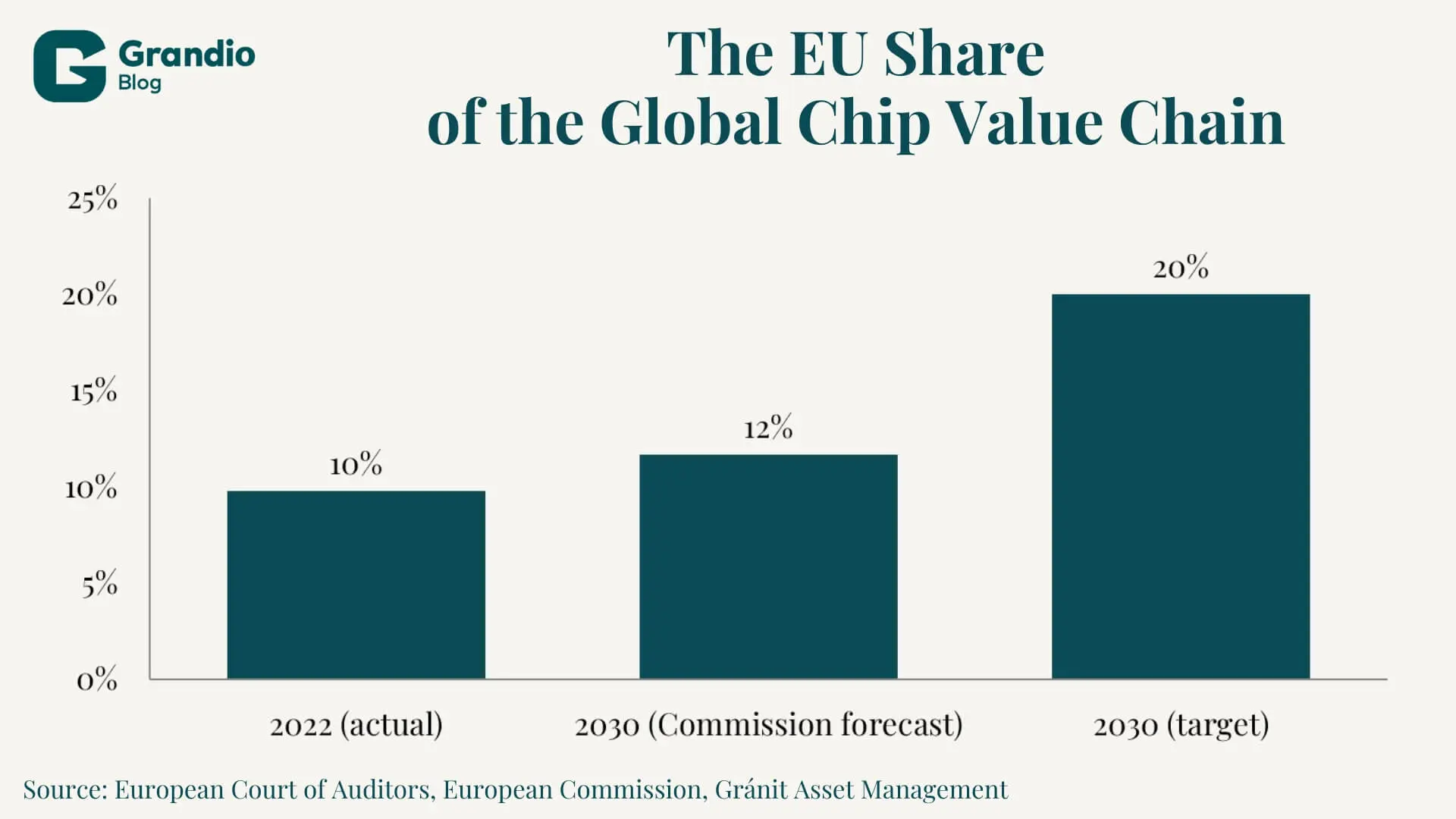
The European Court of Auditors did not mince words in its April 2025 special report, which called the 20 percent global share target for 2030 out of reach, while Annemie Turtelboom, the member who led the audit, described the target as essentially aspirational. The arithmetic explains why: reaching 20 percent would require roughly a quadrupling of European manufacturing capacity by 2030.
Behind the numbers lies a structural problem. Of the estimated 86 billion euros in Chips Act funding through 2030, the Commission manages just 4.5 billion, while the rest is Member State and industry money. For comparison, the leading global manufacturers budgeted 405 billion euros for investment in just three years, between 2020 and 2023. The Commission’s own forecast from July 2024 puts the EU share of the global value chain at 11.7 percent by 2030, up from 9.8 percent in 2022.
It is no surprise that in May 2025 ten Member States, including Germany and France, asked for the target to be revised. The Commission defended it as a device for mobilising large sums of money, which is an honest answer that also concedes the point: it describes a communication tool rather than a business plan.
The One Card Nobody Else Holds
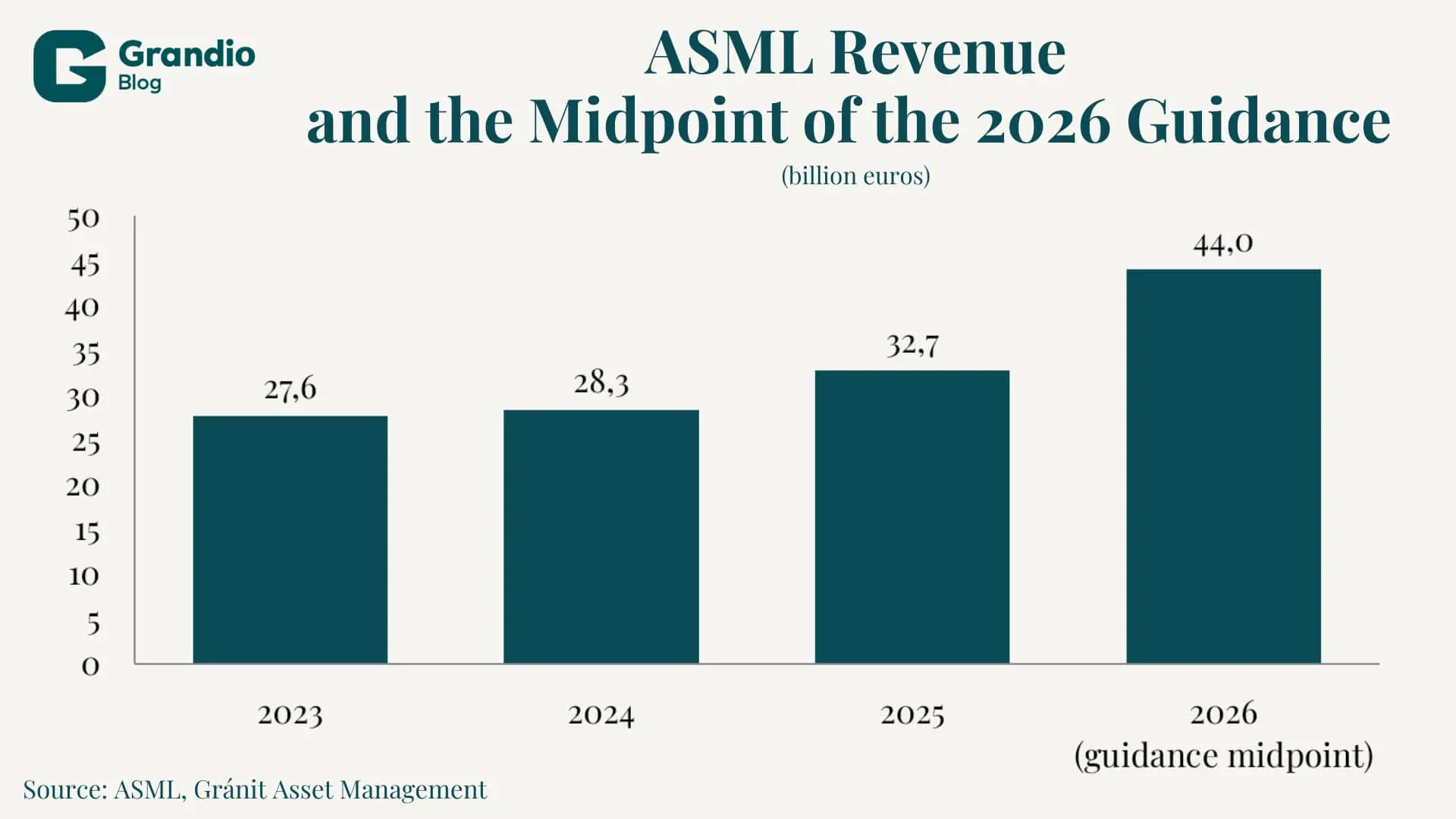
While the manufacturing target kept receding, one European company grew stronger year after year. ASML is the world’s only maker of EUV lithography systems – the machines that print the finest circuit patterns and without which the most advanced chips cannot be built. That is not simply market leadership; it is a monopoly.
Its value is visible in the numbers. Revenue at the Veldhoven company rose from 27.6 billion euros in 2023 to 32.7 billion euros in 2025, and in its second-quarter results published on 15 July, the company raised its 2026 outlook to between 43 and 45 billion euros. That was the second increase within a single year, after a January range of 34 to 39 billion. The driver is the AI investment wave, and every expansion of leading-edge capacity runs through Veldhoven.
Here is the paradox Europe has trouble digesting: fab construction in the United States, Taiwan and Korea all runs through ASML’s order book, yet the tools themselves are installed elsewhere. The most advanced process currently running in Europe is Intel 3 at the company’s Irish site, a generation behind the Taiwanese leading edge. A joint study by the SIA and BCG puts Europe’s share of global fab capacity at 9 percent in 2032, up from 8 percent in 2022. This two-way dependency also carries a price for investors, which I examined in detail in an earlier piece.
Magdeburg, Where the Money Was There and the Demand Was Not
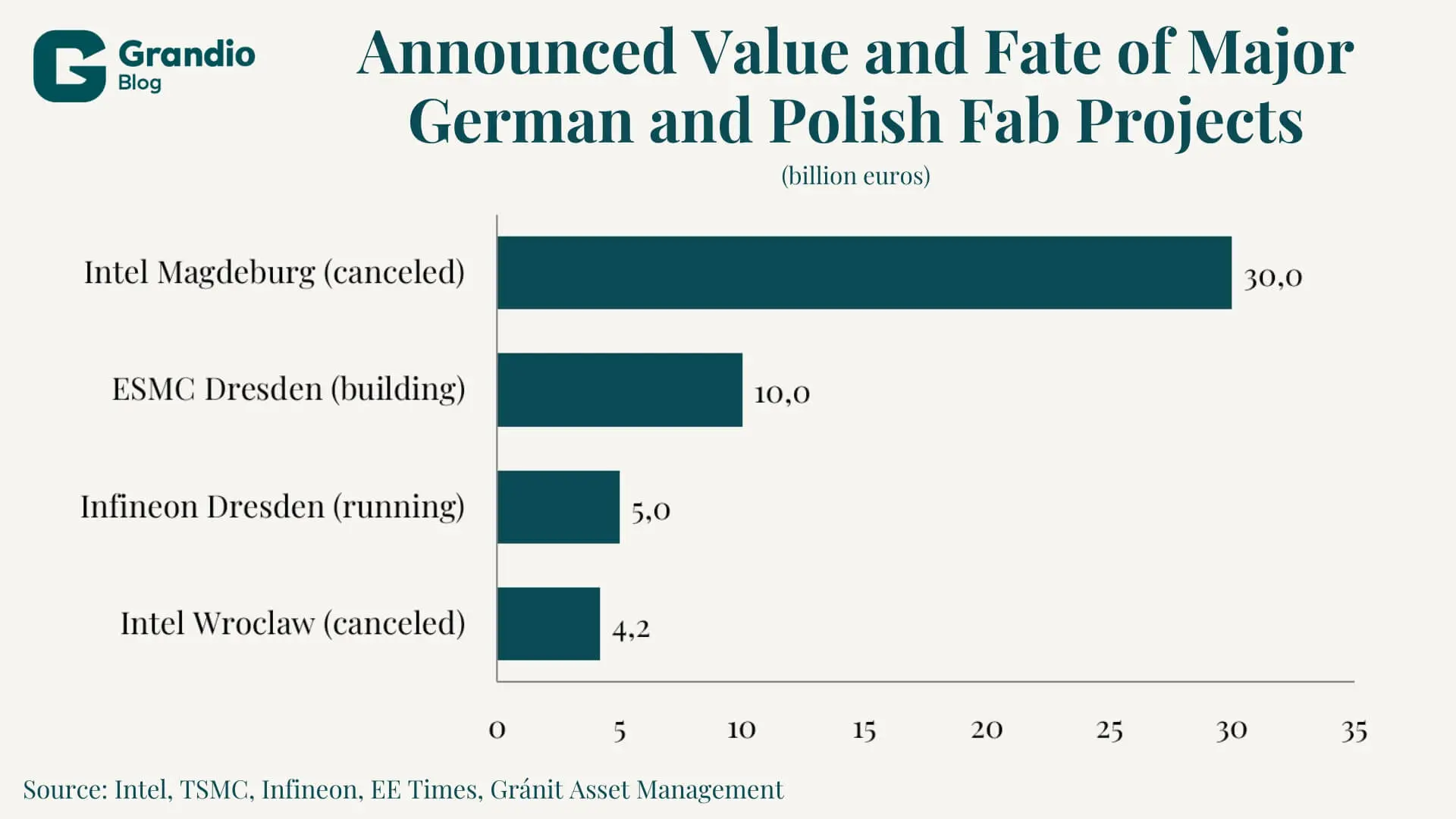
The most expensive lesson in European chip policy was learned in Magdeburg, where Intel announced a 17-billion-euro fab in March 2022, then raised the figure above 30 billion euros in the summer of 2023, with the German government promising roughly 9.9 billion euros in subsidies. The packaging and test plant planned outside Wrocław in Poland was a smaller item at 4.6 billion dollars.
The delay was announced in September 2024, and the outright cancellation followed on 24 July 2025, alongside the second-quarter results. Lip-Bu Tan’s explanation stuck because it was so blunt: he wrote that the company had invested too much too soon without adequate demand and that there would be no more blank checks. The sentence was not about Europe, but the consequences landed on Europe anyway.
The story took a turn in the summer of 2026, when Intel announced a 5-billion-euro expansion at its Irish site in mid-July. The programme is self-funded, comes with no announced state aid, uses cleanrooms that already exist and serves a product line the company says it cannot supply fast enough. Intel did not leave Europe; it simply picked the place where the fab, the engineers and the customers were already in position.
Dresden, Where the Fab Is Not Built on Nothing
Far less attention went to the two fabs that were being built barely 120 miles away. ESMC, owned 70 percent by TSMC, with Bosch, Infineon and NXP holding 10 percent each, is being built in Dresden for more than 10 billion euros, with 5 billion euros in approved German aid. It is designed for 40,000 wafers a month on processes between 28 and 12 nanometres, which means automotive and industrial silicon rather than leading-edge production.
One clarification matters here: that fab is not producing yet, and by its own account, tool installation is due in 2027, with the ramp-up following customer demand. The wording is instructive in itself, because the company does not promise a production date before it knows the demand.
What is already running is Infineon’s Dresden plant, which opened on 2 July 2026, several months ahead of schedule. The 5-billion-euro project is the largest single investment in the company’s history and doubles its Dresden capacity. Ground was broken in May 2023, so the plant went up in three years, while Magdeburg never got a wall in the same period.
The difference is the Saxon ecosystem: Bosch and GlobalFoundries already operated plants in Dresden, which meant that suppliers and engineers were on hand. The lesson is not that subsidies are pointless, but that subsidies alone are not enough, because an ecosystem and a customer base cannot simply be bought.
What 2.0 Promises and What It Leaves Out
The Commission presented the Chips Act 2.0 proposal on 3 June 2026 as part of the European technological sovereignty package. The text would repeal the 2023 regulation, so this is a replacement rather than a patch. The most important change is that demand finally appears: the proposal would use demand accelerators to connect user industries with manufacturers, while grand challenges would support chips the EU considers critical, including AI processors.
The rest of the package also responds to earlier failures: permitting would be capped at 12 months, strategic projects could draw EU funding alongside Member State co-investment, and state aid would become available for first-of-a-kind facilities across the value chain, from raw materials to packaging.
The Commission says the first Chips Act mobilised more than 52 billion euros of public and private investment, but that figure deserves care, because the auditors looked at the same period and concluded that the law does not meaningfully improve the EU’s position. Both claims can be true: mobilised investment is a broadly defined measure, while market share is a stricter one, and it is the latter that investors price. The timing is worth examining as well, because the Commission’s interim evaluation of the first law is not due to Parliament and the Council until September 2026, meaning that the proposal to replace it arrived before the Commission had completed its own evaluation.
The biggest gap is money, because the proposal attaches no specific budget to any of its goals while the debate over the 2028–2034 EU budget is still running. According to a Science Business report in June, Pierre Chastanet, who heads the Commission’s microelectronics and photonics unit, said money would be scarcer under 2.0. The calendar is no kinder: the Commission proposed the first Chips Act in February 2022, and it did not enter into force until September 2023. If 2.0 follows a similar path, the first meaningful effects are unlikely to appear before 2028.
Not Market Share but Indispensability
It is worth noting that the Commission’s own language has shifted: the new proposal no longer repeats the 20 per cent figure and instead talks about the EU remaining an indispensable player in the value chain. Market share measures quantity. Indispensability measures what happens when a player drops out. If ASML stops, no new leading-edge capacity gets built anywhere; if Europe’s share rises from 9 per cent to 11 per cent, however, the market will not even notice.
Two scenarios face each other. In the first, Parliament and the Council move quickly, the next budget puts real money behind the demand-side tools, and European chipmakers build on what they are already good at. In the second, the legislative process drags on, the budget fight grinds down the funding, and the result is a framework that never becomes capacity. On the evidence so far, the second is at least as likely as the first.
For investors, the implication is that European chip exposure should be built around chokepoints rather than legislation. With ASML, what matters is the monopoly and the order book, not the Brussels calendar, while Infineon and STMicroelectronics are priced off automotive and industrial demand, which is cyclical but real. Dutch companies Besi and ASM International connect to the same wave through packaging and deposition. Hungarian investors are exposed twice over, first through the portfolio if they hold any of these names, and second through the real economy, since the domestic automotive industry is one of the largest buyers in the European automotive chip chain.
So the answer to the question in the title is that Europe will not catch up in volume manufacturing, and the Chips Act 2.0 will not change that, because a fab takes three to five years from decision to production, which means today’s construction sites already determine the 2030 capacity picture. Yet at a handful of points in the chain, Europe remains impossible to replace, and the real stake of the next few years is whether it stays that way.
Legal Disclaimer
This document has been prepared by Gránit Alapkezelő Zrt. (registered office: 1134 Budapest, Váci út 17; company registration number: 01-10-046307) for marketing and informational purposes. Accordingly, it has not been produced in accordance with legal requirements designed to promote the independence of investment research. Nor is it subject to any prohibition on dealing ahead of the dissemination of investment research. This document does not constitute investment research or investment advice. Any data presented refers to past performance, and past performance is not a reliable indicator of future results. Each investor must make investment decisions at their own discretion and responsibility.