
In May, OpenAI confidentially filed its registration statement with the SEC, and press reports point to a target valuation of up to $1 trillion, although the latest reports suggest the actual listing could slip to 2027. Meanwhile, according to leaked first-quarter figures, the company lost $1.22 on every dollar it earned, and its announced infrastructure commitments amount to more than 100 times last year’s revenue. SpaceX’s record-breaking June debut opened the sequence, and this autumn OpenAI’s big rival, Anthropic, may be next. The question, then, is what the market is actually pricing, and the first answer grounded in audited numbers will come from Anthropic’s prospectus, expected to become public in early September.
It is rare for a company to announce that it has confidentially filed for an IPO. Yet that is exactly what OpenAI did on 8 June, explaining that news of the confidential submission would leak anyway. According to CNBC, the draft had already reached the SEC on 22 May, with Goldman Sachs and Morgan Stanley leading the process. The filing came days after a California jury dismissed Elon Musk’s lawsuit, which had until then been the biggest legal risk hanging over the listing.
A confidential filing does not lock in a timetable, and the company has not officially committed to a date. Earlier press reports pointed to an autumn listing at a target valuation of between $852 billion and $1 trillion, but according to June reports first carried by The New York Times and picked up by CNBC, the company’s advisers urged caution after SpaceX’s post-IPO share-price slide, and the listing may slip to 2027, as Sam Altman is unwilling to compromise on the trillion-dollar target. Under the SEC’s rules, a confidentially submitted draft must be filed publicly at least 15 days before the roadshow, so the actual timetable will be revealed at the latest when the public S-1 appears. Until then, it is worth piecing together what we already know so that we are prepared when the document lands.
The Wave Has Begun, but the Order Has Changed
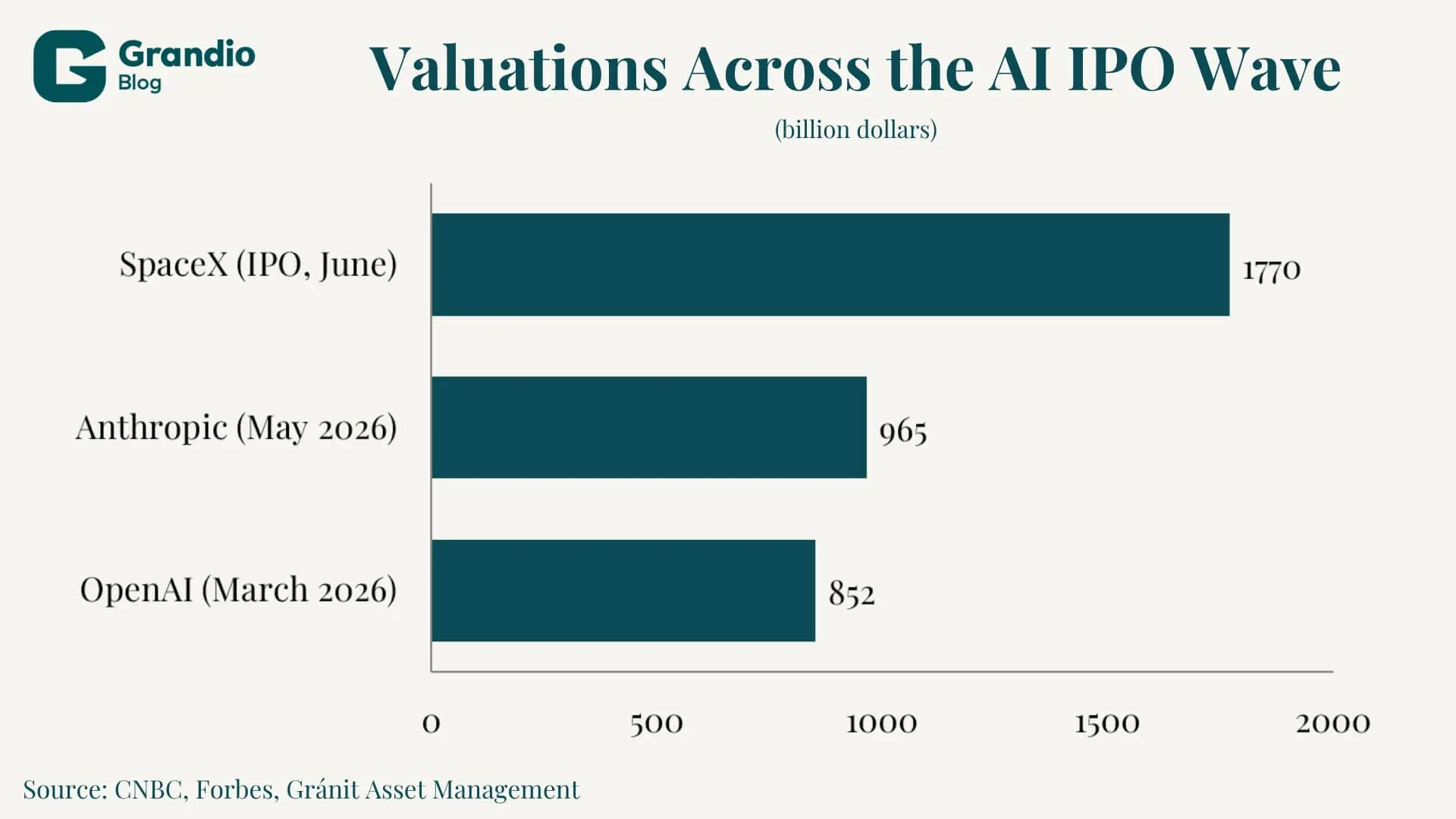
SpaceX opened the sequence, debuting on the Nasdaq on 12 June with xAI folded in following the February acquisition. The company sold roughly 555 million shares at $135 each and raised $75 billion, which CNBC called the biggest IPO ever, with the pricing valuing the company at roughly $1.77 trillion. The stock then rose 19 percent on its first trading day, and SpaceX closed the session with a market value above $2 trillion.
However, the order in which the IPO wave continues has shifted in recent weeks. Anthropic submitted its own confidential draft on the 1st of June and, according to Fortune, was seen in June as capable of beating OpenAI to the public market. According to fresh reports cited by Reuters, the company may publish its prospectus right after Labor Day on 7 September and aim to list in late September or early October, while OpenAI bides its time. Each debut sets a reference point for the next, but the order of these listings carries risk: by the time OpenAI faces investors, two other AI companies may already have tested investor appetite.
Losing $1.22 on Every Dollar Earned
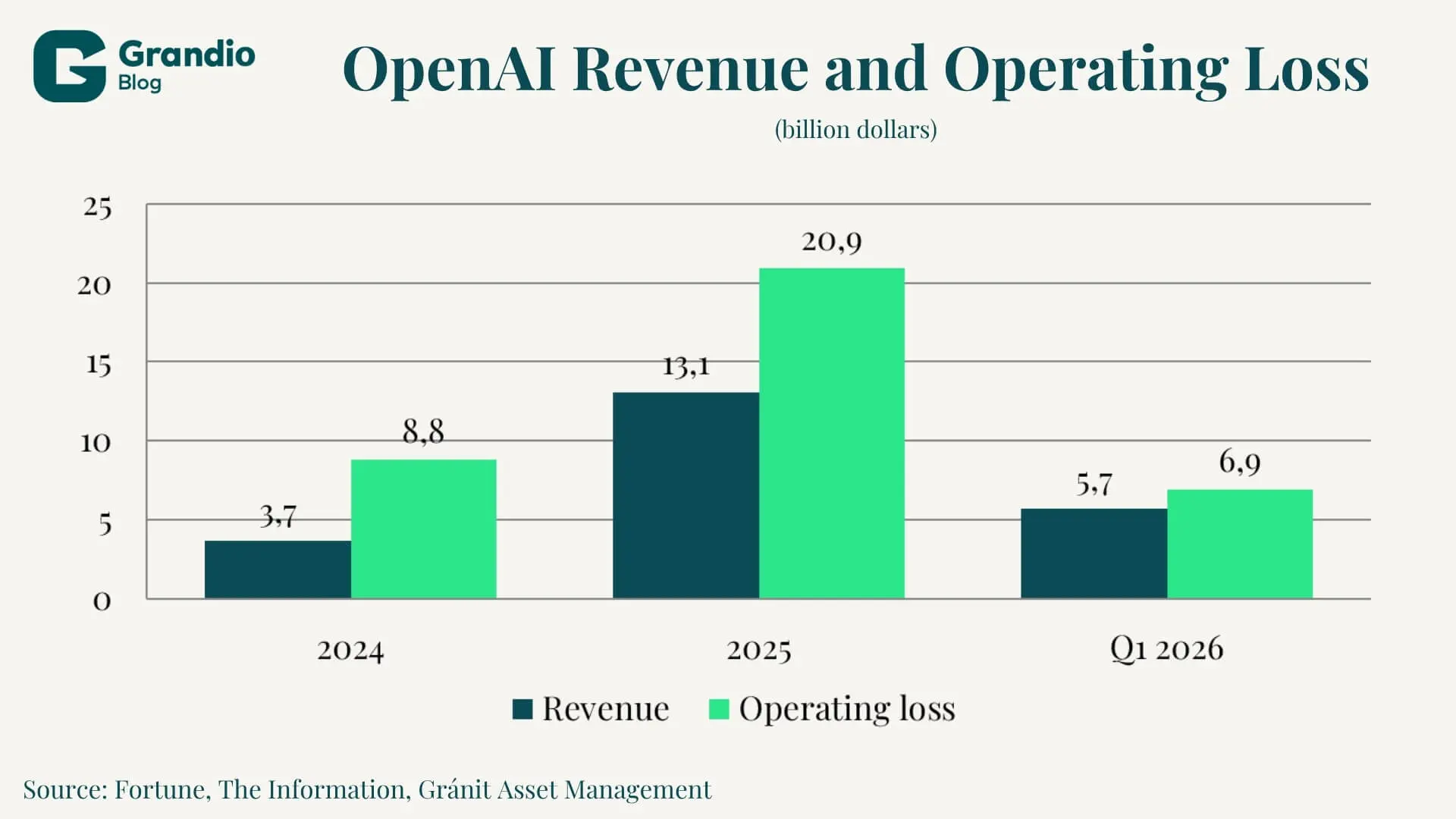
According to financial disclosures obtained by The Information, OpenAI generated $5.7 billion in revenue in the first quarter, a pace of roughly $2 billion a month, while its adjusted operating margin came in at minus 122 percent. In other words, the company lost $1.22 on every dollar it earned, adding up to a loss of nearly $7 billion for the quarter. ChatGPT averaged around 905 million weekly active users, a plateau after the February peak of 920 million, although paying subscribers grew from 47 million to 55 million.
An even more detailed picture of last year emerged in June, when leaked audited financial statements became public. They show that OpenAI generated $13.1 billion in revenue in 2025, up from $3.7 billion in 2024, while its operating loss widened from $8.8 billion to $20.9 billion. The $38.5 billion net loss sounds alarming, but it was inflated by a single $41.55 billion non-cash accounting item tied to the corporate conversion. Research and development spending alone reached $19.2 billion, more than the company’s entire annual revenue.
On the other side of the ledger are future commitments. Last November, in a post cited by TechCrunch, Sam Altman spoke of roughly $1.4 trillion in infrastructure commitments spread over eight years, more than 100 times the company’s 2025 revenue. At the same time, the growth is real: revenue more than tripled in a year. Annualised revenue was already around $25 billion early this year, and according to Bloomberg, it had passed $40 billion by July. That is exactly what the prospectus will reveal: which of the two trajectories proves stronger.
What SpaceX’s Prospectus Revealed and Where Anthropic Differs
SpaceX’s prospectus, made public on 20 May, offered the first full look into the books of a giant that is also building an AI infrastructure business. According to Morningstar, the company generated $18.7 billion in revenue in 2025 with a net loss of $4.9 billion, and the market still paid nearly 95 times revenue at the offering. Part of the high price is explained by Starlink, which provides the larger share of revenue and already operates profitably, while the company’s other business – the AI operation – remains loss-making.
The most quoted detail of the prospectus, however, was not about rockets. According to Axios, Anthropic is paying SpaceX $1.25 billion a month through May 2029 for capacity at the Colossus data centres, a contract worth up to $45 billion over its full term, with a mutual 90-day termination option. It is the first public, contract-level data point on what running a top AI model actually costs. It also shows why power, cooling and data centre capacity have become the bottlenecks of the entire industry, something I explored in my earlier piece on space data centres.
Anthropic, meanwhile, is setting a striking pace. Its February $30 billion round closed at a $380 billion valuation, yet by 28 May the company had announced a $65 billion Series H round at a $965 billion valuation including the investment. Its annualised revenue had crossed $47 billion by May by the company’s own account, while the latest market reports put the figure above $65 billion by the end of July. According to preliminary figures that emerged in mid-August, actual second-quarter revenue exceeded $11.5 billion and the company’s adjusted operating income turned positive. Using the more recent annualised revenue figure, the $965 billion valuation equates to roughly 15 times revenue, far more modest than OpenAI’s target range.
A degree of healthy scepticism is warranted as well. A May analysis in Forbes reported that bankers at the time saw a public-market valuation of between $400 billion and $500 billion as realistic for Anthropic. Seen from this angle, the pre-IPO rounds also serve to ratchet the valuation upwards, since every new private-market price becomes an anchor for the public pricing. And then there is regulatory risk, as the June US export-control case showed, which I covered in an earlier piece.
Expensive Compared with What?
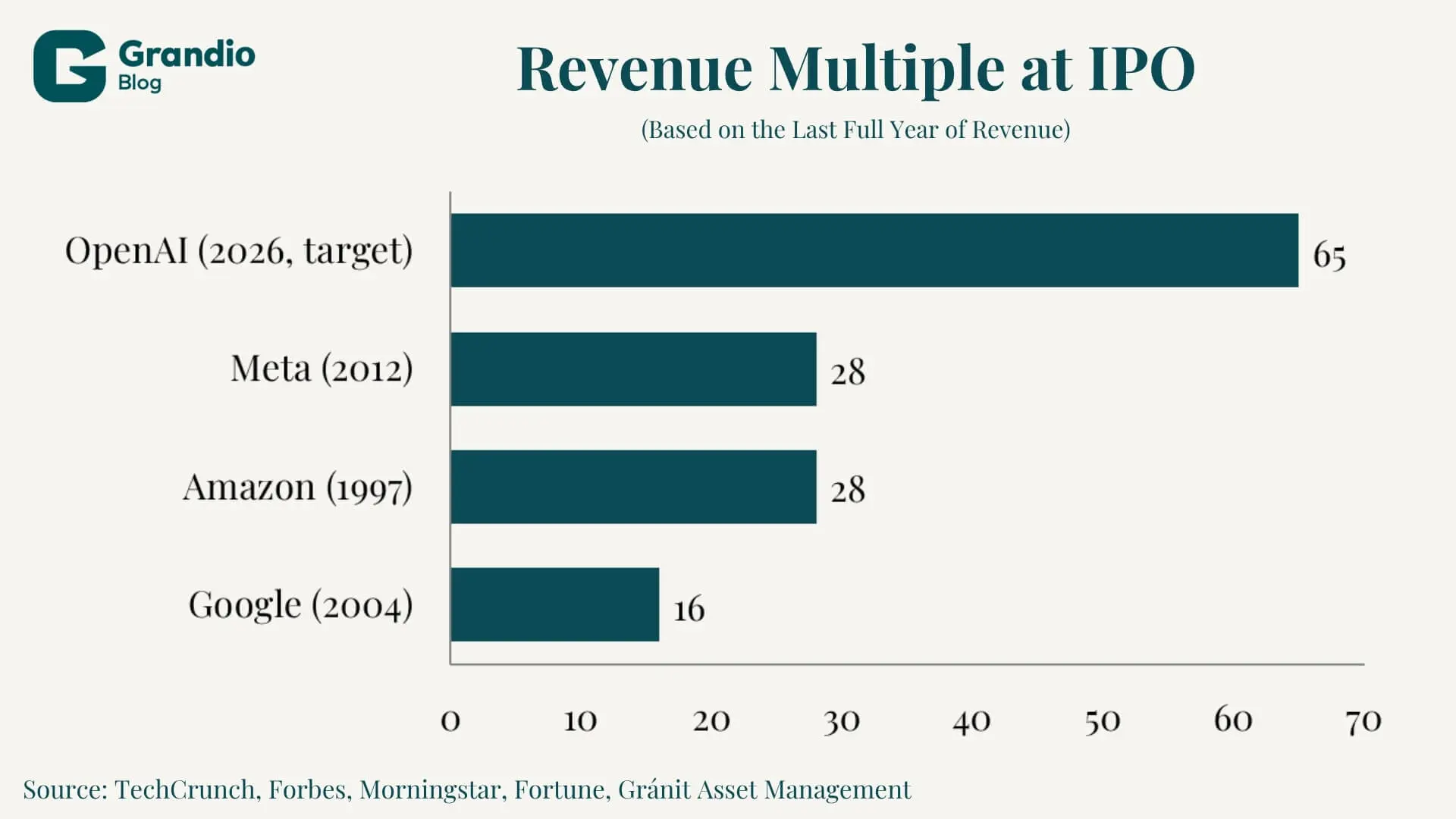
The cleanest measure is the ratio of the valuation at listing to revenue in the last full year before the IPO. Amazon debuted in 1997 at a $438 million market value, 28 times its 1996 revenue of $15.7 million. Google was worth $23 billion at its 2004 listing, 16 times its 2003 revenue. Meta went public in 2012 at a $104 billion valuation, 28 times its 2011 revenue, and for a long time that was the ceiling for large technology debuts.
OpenAI’s target range, by contrast, is 65 to 77 times its 2025 revenue of $13.1 billion, at least double Meta’s record in relative terms. Even using the more flattering annualised revenue of $25 billion from earlier this year, the multiple works out to 34 to 40 times, still above the multiples at which Amazon, Google and Meta went public. SpaceX’s multiple of nearly 95 times shows that the market is willing to pay such prices this year, but there the segment carrying the bulk of revenue is already profitable. In OpenAI’s case, the multiple rests for now on the promise of a future turnaround.
What to Watch for in the Prospectus as an Investor
The public S-1 will be hundreds of pages long, but a few details will decide whether the current target range reflects grounded pricing or mostly hope.
- How revenue is recognised: For AI companies, it matters greatly whether money flowing in through cloud-service partners is booked gross or net, because the difference can run into billions of dollars. The audited S-1 will make the players’ revenue genuinely comparable for the first time.
- The structure of the compute commitments: Within the $1.4 trillion framework, what matters is how much is legally binding, what the schedule looks like and where the exit points are. The 90-day termination option in the SpaceX–Anthropic contract signals that these agreements can be more flexible than the headlines suggest.
- The details of the Microsoft relationship: In 2025, OpenAI paid Microsoft $17.2 billion. Microsoft is both an owner and the company’s most important cloud provider. The payments are spread across several accounting categories, while the largest actual expense line on the income statement was the $19.2 billion spent on research and development. The related-party disclosures will show how deep the dependence really is.
- One-off items and the structure of the losses: Most of the 2025 net loss came from a single non-cash conversion item, yet the operating loss still stood at $20.9 billion. The real question is whether the loss ratio improves as revenue grows, because minus 122 percent cannot be financed indefinitely, even on public markets.
- Free float, lock-ups and the index effect: With a small free float, even moderate demand can detach the price from fundamentals; expiring lock-ups can later bring selling pressure, while index inclusion creates automatic passive buying. According to The Information, Anthropic is weighing letting existing shareholders sell stock in the IPO itself, while imposing a lock-up longer than the customary 180 days on some holders.
The First Moment Audited Numbers Do the Talking
Private-market AI valuations have so far rested largely on leaked statements, investor decks and competing narratives. The current IPO wave is therefore not simply a liquidity event, but the first real market test, where actual buy and sell orders meet the prices set in private rounds. The public S-1 appearing on EDGAR will be the moment when audited numbers take over from the narrative, and the first live pricing – which, on the current timetable, will be Anthropic’s – will be the moment we learn what all of this is worth on the exchange.
Nor will the story remain the concern of American investors alone. If OpenAI and Anthropic enter the major US indexes, they will show up in some Hungarian investor portfolios as well, through passive funds tracking those indexes and the pension portfolios that hold them, whether those savers seek the exposure or not. That is why it matters well beyond the industry whether the trillion-dollar price reflects the next decade’s growth or marks the top of the cycle. The first serious clue will come from Anthropic’s prospectus expected in early September, while the final answer will only arrive with OpenAI’s own listing, whose timing remains open.
Legal Disclaimer
This document has been prepared by Gránit Alapkezelő Zrt. (registered office: 1134 Budapest, Váci út 17; company registration number: 01-10-046307) for marketing and informational purposes. Accordingly, it has not been produced in accordance with legal requirements designed to promote the independence of investment research. Nor is it subject to any prohibition on dealing ahead of the dissemination of investment research. This document does not constitute investment research or investment advice. Any data presented refers to past performance, and past performance is not a reliable indicator of future results. Each investor must make investment decisions at their own discretion and responsibility.