Tesla’s most hyped car had an unveiling that looked more like a rocket test than a car launch. At the event at SpaceX’s test site in McGregor, the car clung upside down to a ramp and jumped over a row of Teslas. A mannequin in a SpaceX spacesuit sat behind the wheel. That was no coincidence, since Musk’s own original Roadster has been orbiting the Sun since 2018, when the first Falcon Heavy carried it into space with a similar dummy, Starman, at the wheel.
The engineering achievement is undeniable, but as investors we need to ask a very different question. When you buy Tesla shares after a show like this, are you investing in a carmaker, or are you really betting that Musk will soon restructure his companies?
Three Versions, None of Them Priced
It is worth starting with what Tesla actually showed, because there are really three different cars. The Performance is the base model for public roads, with no thrusters but with active aerodynamics and fans that suck the car down onto the tarmac. The Thrust, offered in limited numbers, adds cold gas thrusters at the rear, while the Rocket, which seats just one person and is sold by invitation only, can genuinely fly but is not allowed on public roads. Tesla says the Roadster reaches 60 miles per hour from a standstill in 0.81 seconds and that production could start in 2028. That would mean an eight-year delay, since the car was first shown back in 2017 with a $200,000 base price and deliveries were promised for 2020.
The $50,000 figure often quoted as the Roadster’s price is not the purchase price but the deposit for the Performance version, with $5,000 due up front and $45,000 within ten days. For the Thrust the deposit is $250,000, while Tesla has not given a final price for any version. Under the reservation agreement the whole amount is refundable until the buyer configures the car after being invited to do so, but Tesla does not guarantee when it will deliver, or even whether it will deliver at all, and the price is only an estimate.
Even if it is built, the Roadster will barely register in Tesla’s financial results: analysts estimate annual sales of just 2,000 vehicles, compared with the 1.64 million vehicles Tesla delivered last year. Even at $250,000 apiece, that would generate just half a billion dollars, a mere 0.5 per cent of last year’s revenue of $94.8 billion.
Product or Showcase?
Many see the flying version as little more than a marketing stunt, and there is some truth to that. As a car the Rocket hardly matters, since it cannot be used on public roads, so most buyers will probably go for the ordinary Roadster. Tesla’s own quarterly update points the same way, listing the Roadster’s production capacity as yet to be determined and the project as still in design development. The show was therefore aimed mainly at shareholders, signalling that Tesla can pull off technology no traditional carmaker can match, a message that may also help explain Tesla’s high valuation.
The valuation shows this clearly, with Tesla trading at roughly 437 times earnings based on closing prices on November 12 and GAAP earnings per share over the last four quarters, against 10 times for Toyota, 20 for GM, 23 for BYD and 38 for Ferrari. If the market valued Tesla as just another sports car brand, its multiple would be somewhere around Ferrari’s, suggesting that investors assign substantial value to Tesla’s expected future businesses and growth. These include its FSD autonomous driving software with 1.74 million active subscriptions, the Cybercab robotaxi that has been carrying passengers in Austin since September and the Optimus humanoid robot, which is now in production in Fremont.
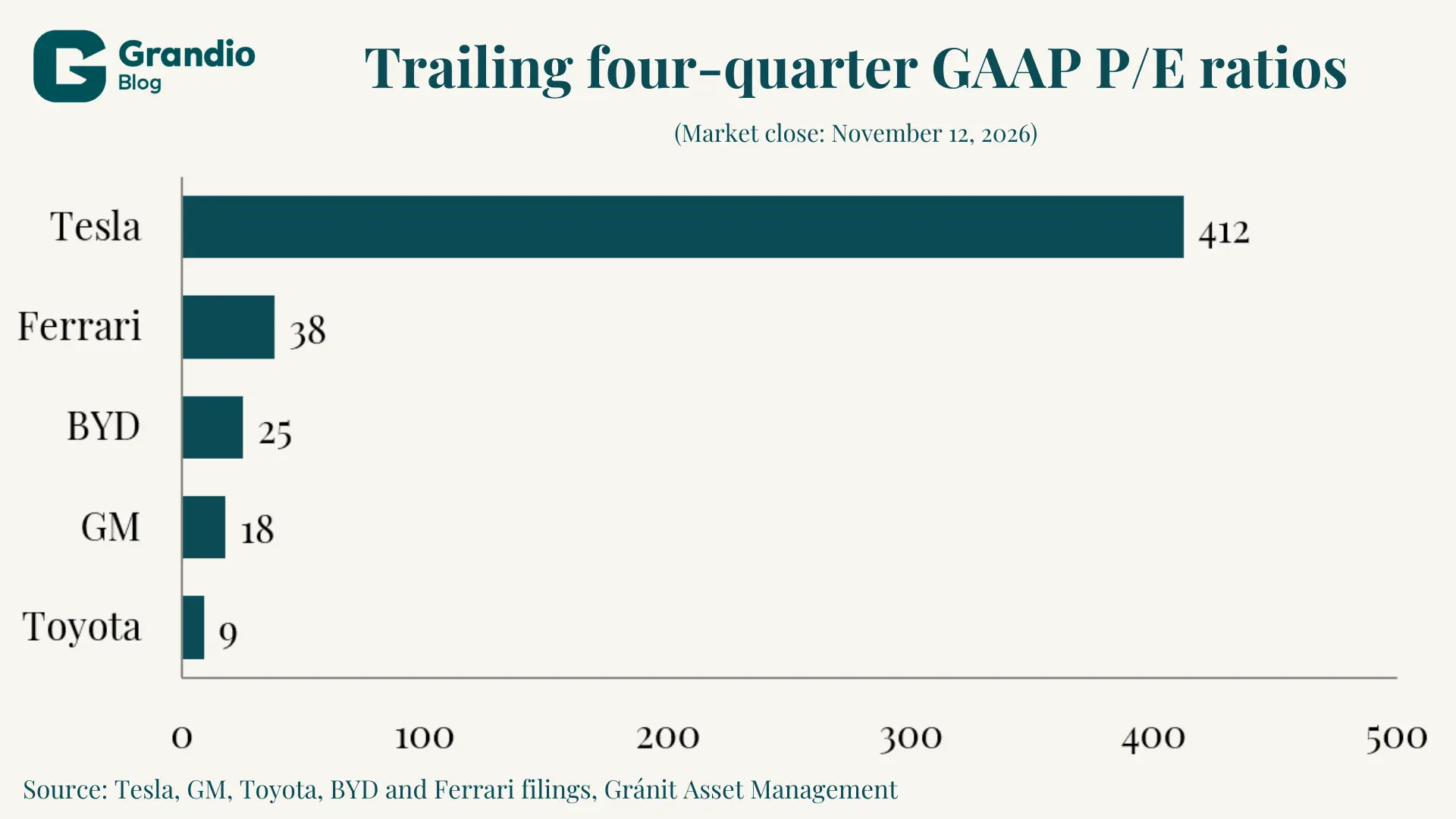
On top of that, Tesla’s earnings for the first nine months of the year include an unrealised gain of $863 million from revaluing its SpaceX shares, so SpaceX is already propping up Tesla’s profit, and without that gain the multiple would be even higher. The money really is flowing into future products, as research and development spending rose from $1.63 billion to $2.76 billion year on year in the third quarter, driven mainly by AI and Optimus, so that it now takes up 10 per cent of revenue.
The Stock Stayed on the Ground
If the show was meant for shareholders, their excitement did not last long, as on October 16 Tesla was up about 4 per cent before the open but closed the day 2.1 per cent lower at $354.72. Since the Nasdaq Composite also lost 2.1 per cent that day, the stock simply moved with the market without a clear positive Roadster effect visible in that day’s closing-price move. Tesla clearly beat the market only the following week, rising 3.8 per cent on October 19 and 3.4 per cent on October 21 while the Nasdaq gained 1.1 per cent on both days, and by then the merger had become the main story, first because of Tesla’s proxy statement and then the SpaceX investor call.
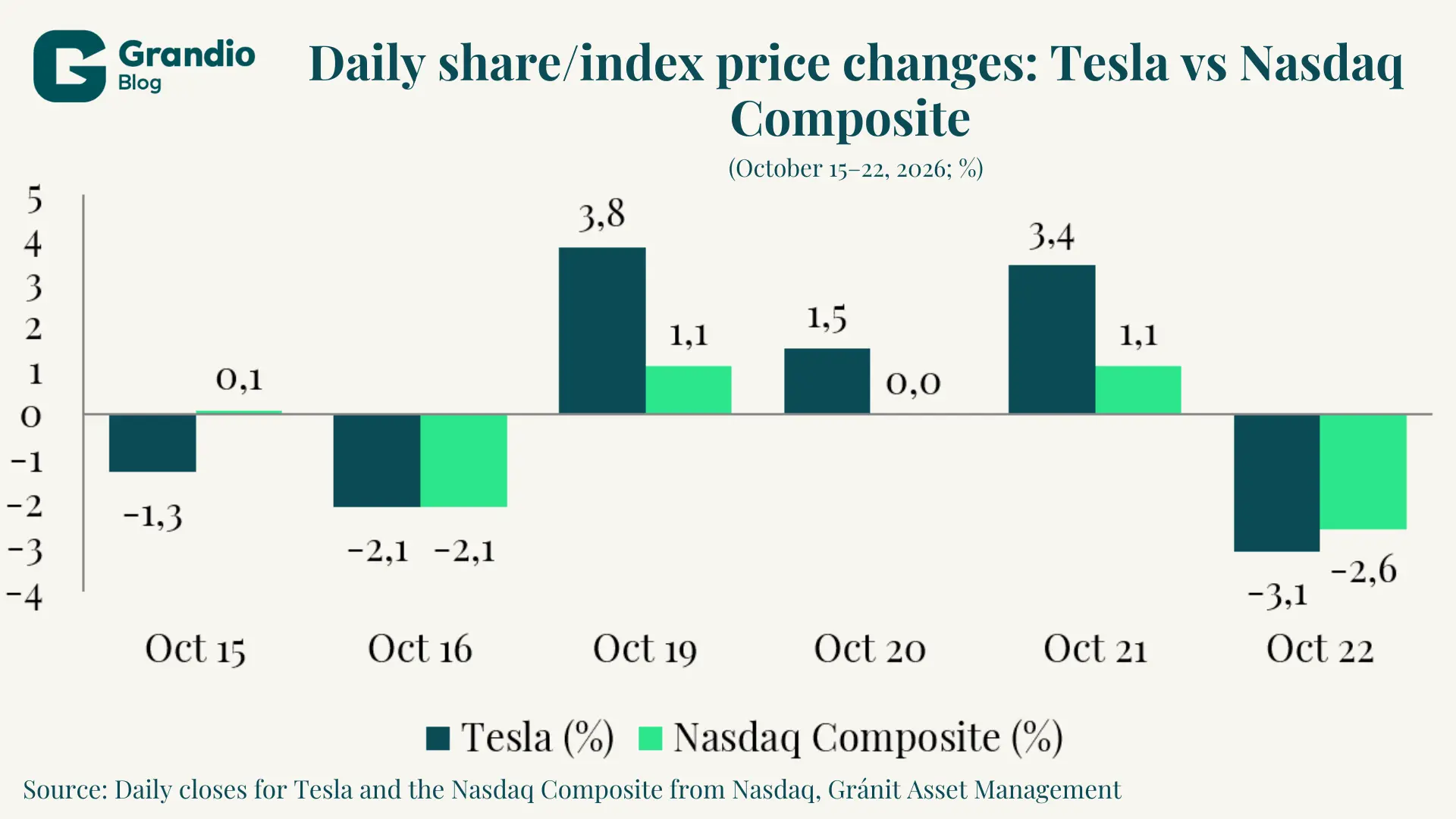
The October 21 earnings report brought no good news either. Revenue was flat at $28.05 billion, with the automotive business down 3 per cent to $20.56 billion and energy down 16 per cent to $2.88 billion, while services were the only growth area, up 33 per cent. Meanwhile operating expenses rose from $3.43 billion to $4.78 billion year on year, so operating income fell from $1.62 billion to $718 million and the margin shrank to 2.6 per cent. Adjusted EPS came in above expectations at $0.48 against $0.45, yet the stock still lost 3.1 per cent on October 22, although the Nasdaq also fell 2.6 per cent that day. The market took the weak car numbers surprisingly calmly, but on November 12 the share price was still 12 per cent lower than at the start of the year. On November 5, after the midterm elections, Tesla fell 10.8 per cent and SpaceX 9 per cent in a single day while the Nasdaq dropped 5.5 per cent, as the Democrats’ victory raised fears that the construction of AI data centres would slow.
The Real Rocket Is the Merger
SpaceX, which went public in June, reported quarterly revenue of $14.6 billion in its October 20 earnings release, up 161 per cent year on year, and more than half of that already comes from the AI business whose plans for orbital data centres I discussed in an earlier article. On the investor call Musk spoke up for a merger, though he added that it would need shareholder backing. He also said that at investors’ request both companies had set up special committees of independent directors, but these have not yet agreed on any terms, and as an interested party Musk himself cannot take part in their work. A Barclays analyst expects SpaceX to buy Tesla in exchange for its own shares, possibly announcing the deal even before Tesla’s December 3 annual meeting. In that case Musk would hold roughly 37 per cent of the combined company’s economic interest and 56 per cent of its votes. According to a Bloomberg report on November 12, the talks are progressing and a deal could be announced as soon as December, although early 2027 has also been discussed. One of the main open questions is how to ring-fence Tesla’s operations in China, which is particularly sensitive given SpaceX’s US military contracts.
This is what matters most for Tesla’s minority shareholders, because Musk owns only 19.8 per cent of Tesla but, according to the SpaceX prospectus, controls more than 80 per cent of the votes at SpaceX. SpaceX’s quarterly report also states plainly that any deal would need the approval not only of the special committee and the board but also of the controlling shareholder, in other words Musk himself. The two companies are already closely intertwined, since Ira Ehrenpreis sits on both boards, Tesla booked $626 million of revenue in the first nine months of the year from SpaceX buying its Megapack industrial batteries and Tesla’s $2 billion investment in xAI has been converted into SpaceX shares. For minority shareholders, the question is how large a premium the special committee can secure in a deal where the largest shareholder has interests on both sides of the deal.
Where Things Actually Fly
If we look at the air taxi market, the world of electric aircraft that take off and land vertically (eVTOLs), the pace is entirely different. Joby was awarded exclusive rights in Dubai for six years in 2024, but according to its November 4 shareholder letter, with its second vertiport now complete, it plans for now only to begin piloted test flights there this year, and it has not given a date for the first passenger flight. In the United States it is in the final stage of type certification, and its passenger revenue is not expected to accelerate before 2028. Archer says it was the first to complete the third of four phases in the certification process of the Federal Aviation Administration (FAA), and on August 9 it reached a deal with Boeing to take over Wisk, Insitu and SkyGrid, paying mostly in its own shares.
In China, EHang received the first type certificate for a passenger eVTOL back in 2023, but in August it withdrew its revenue guidance of 600 million yuan for 2026 after regulators slowed passenger approvals following an air accident in June. Aridge, Xpeng’s flying car unit, has collected some 7,000 advance orders for its modular flying car at a price of roughly $280,000, but it still does not have a Chinese type certificate.
In Europe, the AirCar built by Slovakia’s Klein Vision already holds a certificate of airworthiness and has flown more than 170 hours and taken off and landed more than 500 times, while its production prototype is offered for between $800,000 and $1 million. However, flying it takes a pilot’s licence and taking off needs an airport. The cautionary tales are European too, as Lilium went bust for the second time in February 2025 and Volocopter ended up in Chinese hands after its December 2024 insolvency filing. These cases show that a real flying vehicle takes years of certification work and a great deal of capital.
The Share Exchange Ratio Matters More Than 0.81 Seconds
The Roadster was more of a spectacular preview of the merger than Tesla’s next source of revenue. For shareholders, then, the exchange ratio the two special committees eventually agree on matters far more than the acceleration time. At November 12 closing prices one Tesla share is worth roughly 2.8 SpaceX shares before any premium, so every piece of merger news in the coming weeks is worth measuring against that number. Joby’s planned test flights in Dubai will offer an indication of progress towards commercial air-taxi operations, and 2028 will show what the Roadster promise was worth. By then, however, the merger will most likely have decided the fate of Tesla’s stock.
Legal Disclaimer
This document has been prepared by Gránit Alapkezelő Zrt. (registered office: 1134 Budapest, Váci út 17; company registration number: 01-10-046307) for marketing and informational purposes. Accordingly, it has not been produced in accordance with legal requirements designed to promote the independence of investment research. Nor is it subject to any prohibition on dealing ahead of the dissemination of investment research. This document does not constitute investment research or investment advice. Any data presented refers to past performance, and past performance is not a reliable indicator of future results. Each investor must make investment decisions at their own discretion and responsibility.