
Most of the world’s most advanced chips are made on a single island that is both earthquake-prone and geopolitically exposed, largely in the fabs of one company: Taiwan’s TSMC. Many flagship products from Nvidia, Apple and other leading companies depend on it.
The world is responding to this risk with a wave of fab construction stretching from Arizona through Japan to Dresden. Yet the same process is eroding Taiwan’s silicon shield – the protection the island derives from being indispensable. The question is who wins and who loses as the world’s most valuable industry transforms and decentralises, and how much exposure to Taiwan the average investment portfolio carries. Much of the answer depends on how the new fabs ramp up over the next few years.
Before dawn on 3 April 2024, a magnitude 7.4 earthquake – Taiwan’s strongest in twenty-five years – struck the island, and within minutes semiconductor supply became the leading topic in international news. TSMC evacuated its fabs in accordance with protocol. As CNN reported, more than 70 percent of its tools were back online within ten hours, allowing markets to breathe a sigh of relief.
The episode nevertheless laid bare the central issue: roughly 90 percent of the world’s most advanced chips are made on a single island that lies in an earthquake zone and is separated from mainland China by a strait only about 80 miles wide at its narrowest point.
In an earlier piece, I explored technological dependency through the lens of AI models, asking what happens when Washington can switch off an operating service with a single stroke of the pen. In semiconductor manufacturing, the dependency is even more concentrated: what would need to be replaced is not merely a supplier, but essentially a single physical location.
This article therefore examines how perhaps the greatest concentration in industrial history came into being, why it protects Taiwan in particular, and why the wave of fab construction designed to reduce this dependence is simultaneously weakening that protection.
The Engineer Who Founded Today’s Most Important Company at 55
Morris Chang spent a quarter of a century at Texas Instruments in the United States but was passed over for the top job. In 1985, he instead accepted the Taiwanese government’s invitation to lead the Industrial Technology Research Institute, or ITRI.
Two years later, in 1987, he founded TSMC on a business model that many considered unviable at the time. The company would neither design nor sell chips of its own, but would exclusively manufacture designs created by other companies. This is the pure-play foundry model, whose foundation is trust: the manufacturer never competes with its own customers.
Until then, the semiconductor industry had been dominated by integrated manufacturers such as Intel, which designed and manufactured their own chips. Separating the two activities opened the door for fabless design companies, which no longer had to build multibillion-dollar plants in order to sell chips.
Nvidia, Qualcomm and, in effect, Apple’s chip-design operation all emerged from this model, while manufacturing itself became increasingly concentrated in one place: Taiwan.
The Other End of the Value Chain – and Why No One Has Yet Replicated It
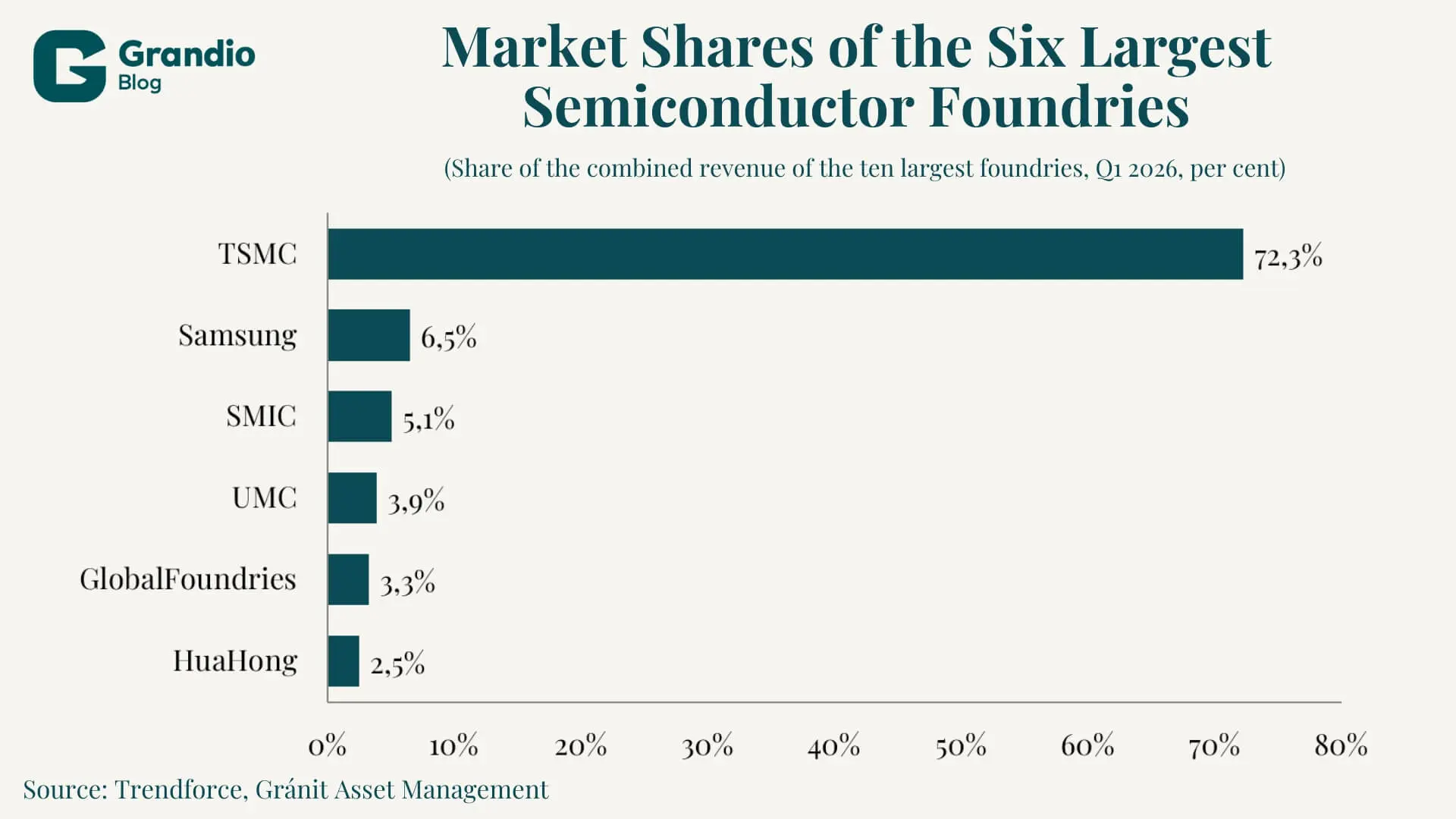
Today’s figures border on the absurd. According to TrendForce, TSMC alone accounted for 72.3 percent of the combined revenue of the ten largest foundries in the first quarter of 2026. Second-placed Samsung stood at 6.5 percent, leaving an approximately elevenfold gap between the two companies.
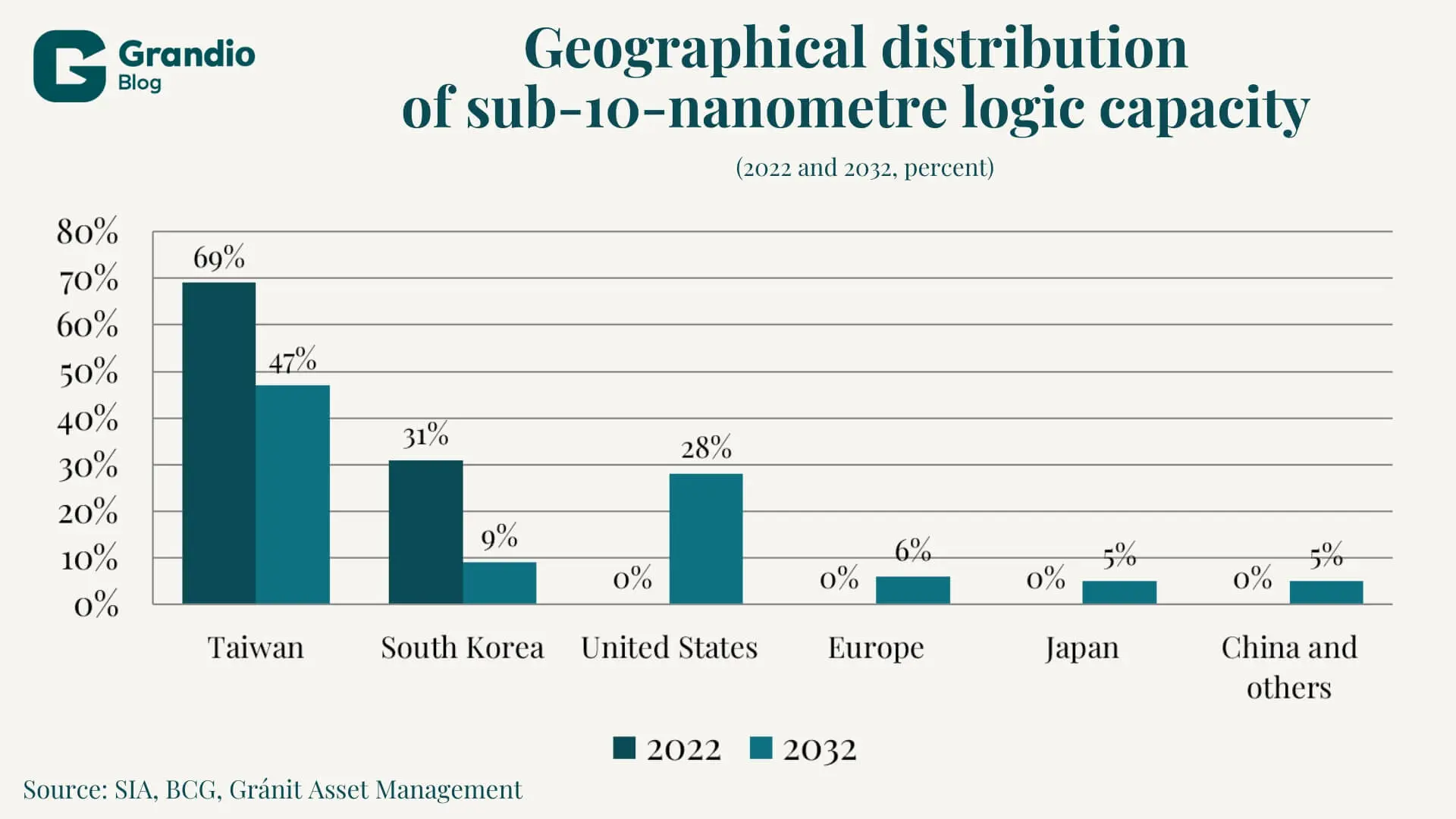
At the leading edge, the concentration is even more pronounced. A joint study by the Semiconductor Industry Association and BCG found that in 2022 Taiwan held 69 percent of global logic manufacturing capacity below 10 nanometres, while South Korea held the remaining 31 percent. The United States had virtually none.
At the other end of the dependency chain stand the world’s most valuable companies. Apple was TSMC’s largest customer for a decade, but the AI boom reshuffled the ranking in 2025. According to an annual filing reported by Taiwan News, Nvidia moved into first place with 19 percent of revenue, while Apple’s share fell to 17 percent.
In practice, this means that flagship iPhone processors and Nvidia data-centre accelerators come from the same handful of Taiwanese fabs. Of TSMC’s $35.9 billion in first-quarter 2026 revenue, 74 percent came from its most advanced process nodes – those at 7 nanometres and below.
The obvious question is why no other company has entered a business this profitable at anything approaching the same scale. Samsung starts from a position of mistrust because it also manufactures phones and designs chips of its own. Every potential customer may therefore also be a competitor, making other companies more reluctant to hand over their chip designs.
Intel is approaching the challenge from the opposite direction. As an integrated manufacturer with its own fabs, it is now attempting to expand into contract manufacturing. Yet, as CNBC summarised in January, it has yet to secure a customer willing to entrust it with flagship products at scale.
The deeper reason lies in yield: the proportion of chips produced on a silicon wafer that emerge without defects. This single metric determines whether production is economically viable. High yield cannot simply be purchased. It accumulates over decades through the experience of successive generations of engineers.
TSMC’s advantage is therefore not one machine or one patent, but the manufacturing know-how and supplier density built up in Taiwan. This is precisely what is most difficult to transplant to another continent.
The Silicon Shield: Taiwan’s Peculiar Geopolitical Life Insurance
Taiwan’s indispensability gave rise to the concept of the silicon shield. The idea is that Taiwan’s semiconductor industry itself partly protects the island from a Chinese attack: an invasion would paralyse one of the global economy’s most important industrial centres, a cost that Beijing itself could scarcely afford.
Capturing the fabs alone would be of limited value. Without ASML’s Dutch lithography machines, the global supply of specialist chemicals and Taiwan’s engineers, the buildings themselves would be worth little.
From the perspective of the United States, the same logic applies. Nearly one-third of new computing capacity continues to depend on chips fabricated in Taiwan, making the defence of the island a direct American economic interest.
Taiwan’s government consciously maintains this shield. In the spring of 2025, it reinforced the so-called N–1 rule at the legislative level. Under this principle, the most advanced process technology of the day may not be transferred abroad; overseas fabs may receive only technologies at least one generation behind the domestic leading edge.
The centre of gravity of research and development also remains on the island. In late 2025, Taipei began debating an even stricter version that would retain a two-generation lead at home. The shield, in other words, is not an accident but a deliberately maintained strategic position.
The Great Relocation from Arizona to Dresden
The world is nevertheless unwilling to rely solely on the stability offered by the shield. The largest geographical restructuring in the history of the semiconductor industry is therefore under way.
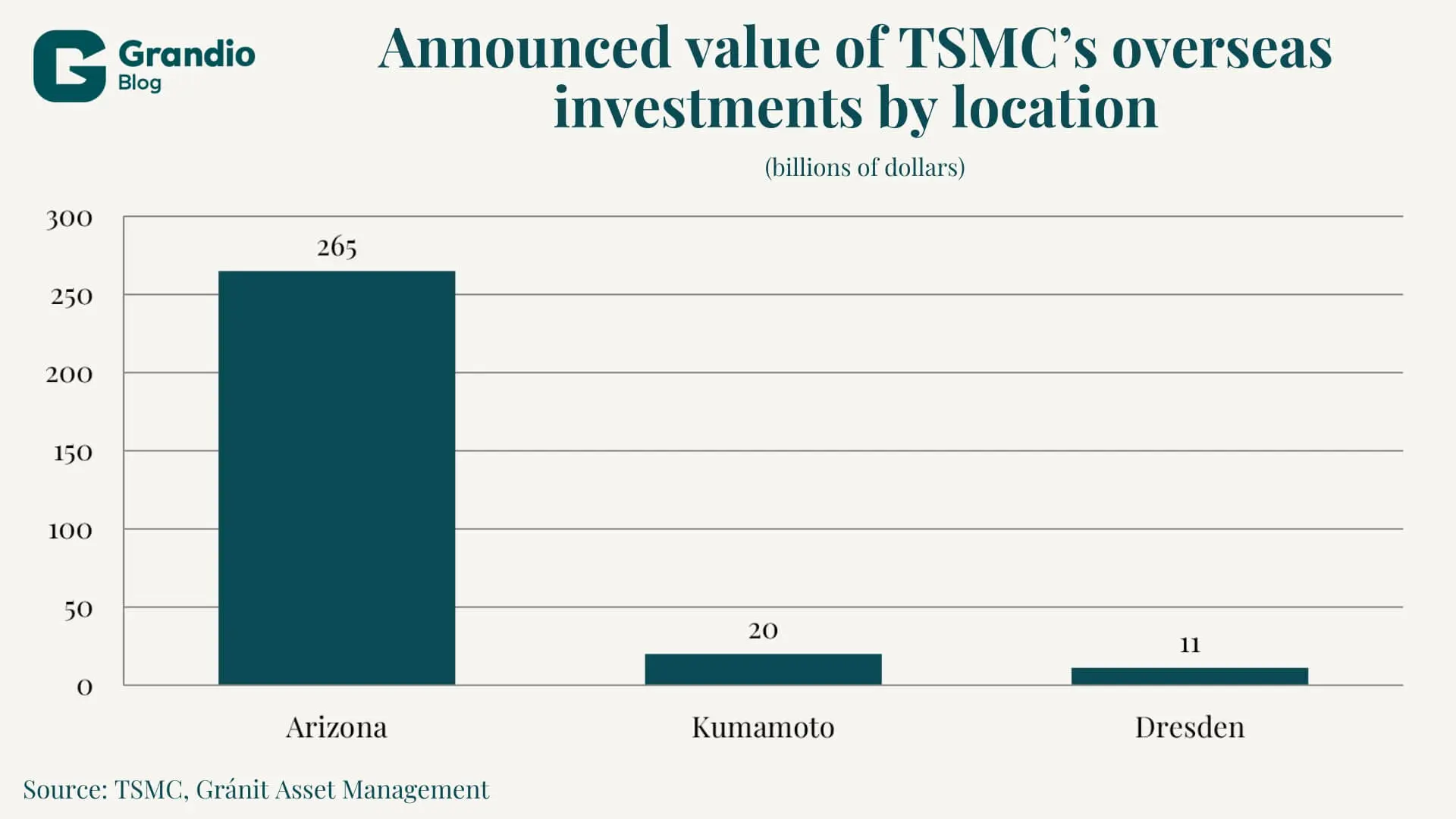
TSMC’s Arizona project began in 2020 as a $12 billion investment. By March 2025, it had expanded to $165 billion, covering six fabs, two advanced packaging facilities and an R&D centre. It represented the largest single foreign direct investment in US history.
The first fab has been in volume production since late 2024. In October 2025, Nvidia and TSMC unveiled the first Blackwell wafer manufactured on American soil – the silicon disc at the heart of the most sought-after AI chip.
For packaging – the final assembly of chips into finished units – this symbolic wafer still travels back to Taiwan because the first US packaging facilities are still under construction. Nevertheless, CEO C. C. Wei has said that once the build-out is complete, around 30 percent of TSMC’s capacity at 2 nanometres and below could operate in Arizona.
In Japan, TSMC is investing through JASM, a joint venture with Sony, Denso and Toyota. Combined investment in the two Kumamoto fabs exceeds $20 billion, and the first plant has been in volume production since the end of 2024. Plans for the second fab were upgraded in 2026 to include 3-nanometre production, demonstrating how technology deployed outside Taiwan is moving ever closer to the leading edge.
In Europe, the flagship project is ESMC, the Dresden fab jointly owned by TSMC, Bosch, Infineon and NXP. Of its total cost of more than €10 billion, the German state has committed €5 billion under the EU Chips Act. Production is expected to begin in late 2027, focusing primarily on automotive chips.
The Escape Itself Is Weakening the Shield
Here lies the paradox that may become one of the defining geopolitical questions of the next decade. Every new fab in Arizona, Kumamoto and Dresden reduces supply-chain risk, but it also reduces Taiwan’s indispensability. The silicon shield draws its strength from precisely that indispensability.
The Semiconductor Industry Association and BCG project that by 2032 Taiwan’s share of sub-10-nanometre capacity will fall from 69 to 47 percent, while the US share will rise from zero to 28 percent. The reshuffling is therefore not merely a plan, but a process already under way.
In Taiwan, this has become a heated domestic political debate. As MIT Technology Review has reported, the opposition speaks of the island being hollowed out and “de-Taiwanised”, while Beijing deliberately amplifies this narrative because uncertainty alone weakens the island.
The US–Taiwan trade agreement announced in January 2026 reinforced the status quo in the short term. Analysts argue that the shield may hold until the end of the decade because R&D and the most advanced production remain concentrated on the island.
Over the longer term, however, the direction is clear. Once the 2-nanometre fabs in Arizona and the 3-nanometre plant in Japan ramp up, the world will become progressively less dependent on the single island it currently has a compelling interest in defending.
Who Wins, Who Loses and What Is in Investors’ Portfolios?
From an investor’s perspective, the list of winners is longer than the list of losers. Nvidia, Apple and TSMC’s other major customers benefit because their production risks are reduced. Manufacturing may become more expensive, however, and the premium will ultimately be borne by chip buyers.
TSMC benefits as well. Governments and customer demand are financing much of its geographical expansion, while its technological lead remains intact for the time being.
The quiet long-term loser may be Taiwan’s geopolitical bargaining position. This is precisely the risk that markets currently appear to price only to a limited extent, as the share prices of TSMC and its customers primarily reflect growth.
The next few years may unfold according to one of two scenarios. If the new fabs ramp up slowly, manufacturing concentration in Taiwan – and therefore the shield – may remain largely unchanged for years. If overseas yields and packaging capacity develop according to plan, however, the island’s strategic weight could decline noticeably by the early 2030s.
This affects Hungarian investors even if they have never purchased a TSMC share. Through Nvidia, Apple and TSMC itself, many global technology ETFs carry substantial direct or indirect exposure to Taiwan’s geopolitical risks.
The first indication came with TSMC’s 16 July earnings report. The company reported quarterly revenue of $40.2 billion and a 77.4 percent year-on-year increase in net profit. Processes at 7 nanometres and below accounted for 77 percent of wafer revenue, while the latest 2-nanometre generation appeared in the revenue mix for the first time.
On the same day, C. C. Wei announced that TSMC would invest another $100 billion in Arizona, lifting the total to $265 billion. The relocation that is weakening the shield is therefore accelerating rather than slowing.
The central question will remain with us for years. The fate of the silicon shield does not rest on a single quarter, but on a decade of fab ramp-ups.
Legal Disclaimer
This document has been prepared by Gránit Alapkezelő Zrt. (registered office: 1134 Budapest, Váci út 17; company registration number: 01-10-046307) for marketing and informational purposes. Accordingly, it has not been produced in accordance with legal requirements designed to promote the independence of investment research. Nor is it subject to any prohibition on dealing ahead of the dissemination of investment research. This document does not constitute investment research or investment advice. Any data presented refers to past performance, and past performance is not a reliable indicator of future results. Each investor must make investment decisions at their own discretion and responsibility.