
The US CHIPS and Science Act was enacted in 2022 with the aim of bringing semiconductor manufacturing back to the United States and strengthening integrated manufacturers that operate their own fabs, led by Intel. Yet these were not the companies the market rewarded most. Instead, investors favoured companies that own no fabs at all and outsource the manufacturing of their chips.
Nvidia, AMD and Qualcomm – so-called fabless companies that design chips but leave production to external manufacturers – emerged among the main stock market winners. How can legislation intended to reshore manufacturing benefit the very companies that own no factories? The answer lies in where value and risk are concentrated in today’s semiconductor industry.
The technology war has long been about more than tariffs and export controls. It is also about where the world’s most advanced chips are manufactured. In an earlier article, I examined how markets price the defence industry’s cost paradox. This article explores a similarly counterintuitive outcome in the semiconductor industry.
In 2022, the United States sought to address its dependence on foreign manufacturing capacity through the CHIPS and Science Act, mobilising tens of billions of dollars to support the construction of new fabs on US soil and reduce reliance on Taiwan’s manufacturing capacity. The logic appeared straightforward: build a factory in the United States and receive a share of the funding. The stock market, however, sent a very different message.
The Law Wanted One Thing, but the Market Rewarded Another
In my research, published in Közgazdasági Szemle, I examined the key milestones in the legislative process and analysed how individual semiconductor stocks reacted to them.
The strongest positive response came in the summer of 2022, when it became clear that the Senate would use an already active bill as the legislative vehicle for moving the regulation forward under an accelerated timetable. Surprisingly, design companies – above all Nvidia, AMD and Qualcomm – were among the biggest winners. Intel, the law’s intended main beneficiary, and other integrated manufacturers operating their own fabs showed some of the weakest market reactions.
The contradiction is clear. The CHIPS Act explicitly sought to strengthen domestic manufacturing and therefore the companies that own factories. Yet investors bid up the shares of businesses that do not manufacture a single wafer themselves.
Why Did the Fabless Companies Benefit?
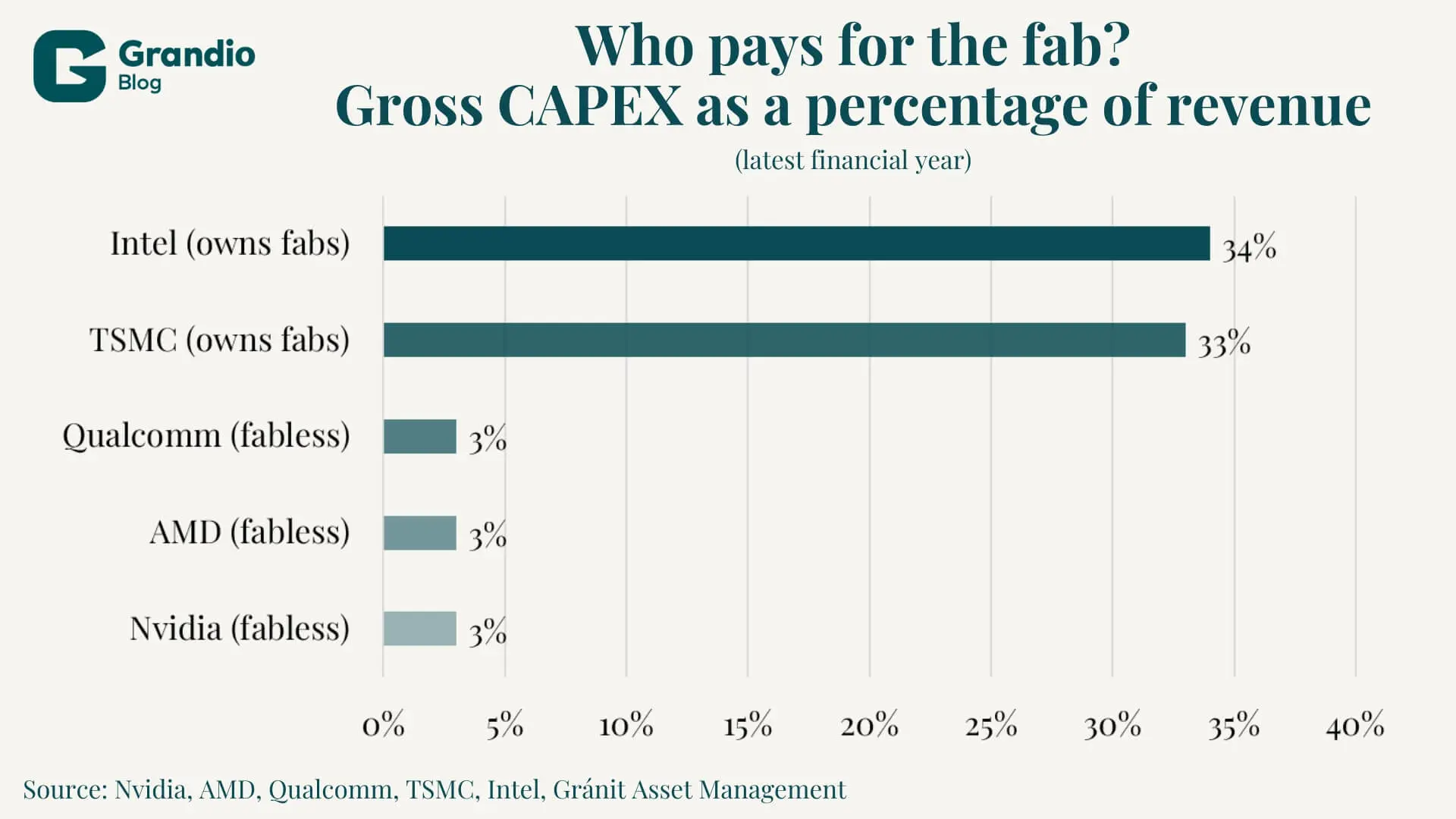
The explanation is simpler than it first appears. Fabless companies control one of the most valuable parts of the semiconductor value chain: chip design. They leave the capital-intensive “dirty work” of manufacturing and building multibillion-dollar fabs to other companies.
A modern semiconductor fab can cost more than USD 20 billion and take several years to complete. Companies such as Nvidia do not have to bear the direct cost and construction risk of these facilities, while still gaining access to the resulting manufacturing capacity.
The CHIPS Act brought to the United States precisely the kind of manufacturing capacity that can serve orders from fabless companies. In other words, the legislation created closer, more predictable and geographically safer production capacity for firms that do not have to finance the construction of their own factories because they outsource manufacturing.
The design company avoids the direct cost of building a fab, yet still receives a more stable and geographically secure manufacturing base for its chips, farther away from the geopolitical risks surrounding the Taiwan Strait. It is difficult to imagine a more favourable arrangement – and the market recognised it.
Equipment manufacturers such as the Dutch company ASML also benefited significantly. This is logical: more factories mean more orders for semiconductor manufacturing equipment. The gains made by fabless companies were more surprising because, on paper, they are the participants furthest removed from actual manufacturing.

Intel: The Intended Protagonist That Fell Behind
Intel stood at the centre of the debate surrounding the legislation, yet its shares showed an exceptionally weak reaction. This was partly due to unfortunate timing, as the company published a disappointing quarterly report in the summer of 2022, but structural factors also played an important role.
Intel follows the traditional integrated model: it designs, manufactures and tests its own chips. Alongside the financial support offered by the CHIPS Act, it therefore also assumes the full risk associated with constructing and operating semiconductor fabs.
Since 2021, Intel has announced more than USD 100 billion in US manufacturing investment, with its largest projects located in Arizona and Ohio. Nevertheless, Intel’s foundry division continues to record operating losses amounting to billions of dollars, while external customer demand remains limited. The company fell behind its competitors technologically following a series of poor corporate decisions.
Intel’s strategic importance is illustrated by the fact that the US government acquired a passive stake of approximately 9.9 per cent in the company, effectively assigning it the role of a national champion.
The company has begun shipping its first proprietary products manufactured using the advanced 18A process. Whether it can attract enough external foundry customers for the next generation of manufacturing technology, however, remains an open question. It is also telling that Intel continues to rely on external foundries, including TSMC, to manufacture some of its advanced products.
Foundries and Geography: TSMC’s Arizona Turn
When the legislation was first announced, the market initially treated Taiwan’s TSMC as one of the potential losers. Investors feared that reshoring would work against the company and weaken Taiwan’s geopolitical shield, with negative consequences for TSMC itself.
It later became clear that reshoring was not working against TSMC but in its favour. In July 2026, the company increased its total US investment commitment, focused mainly on Arizona, to USD 265 billion. Its first Arizona facility is already producing four-nanometre chips at scale, including for customers such as Apple, Nvidia and Qualcomm.
This development makes the earlier argument tangible. The closer and safer manufacturing capacity promised to fabless companies is no longer merely a plan: it is now an operating fab on US soil.
The financial results also demonstrate that the model is working. TSMC’s Arizona subsidiary generated a profit in its first full financial year, and in the first quarter of 2026 it reported a higher net profit than it had generated during the whole of 2025.
TSMC also controls approximately 72 per cent of the pure-play semiconductor foundry market. Consequently, regardless of where a chip is designed, a considerable share of the economic benefit is likely to flow to TSMC as well.
What Does This Mean for Investors Today?
The market reaction to TSMC’s additional investment plans in 2022 anticipated a lasting structural advantage, and the subsequent years have largely confirmed that assessment. Nvidia and AMD shares have increased several-fold, while TSMC has become an indispensable participant in the semiconductor industry.
It is important, however, to recognise that this surge is now driven primarily by the AI boom, rather than by the CHIPS Act or its policy achievements alone.
The real change surrounding Intel began in the second half of 2025 and continued into 2026. Shares in the long-written-off semiconductor giant rebounded sharply after the US government acquired a stake in the company and Nvidia invested USD 5 billion in Intel.
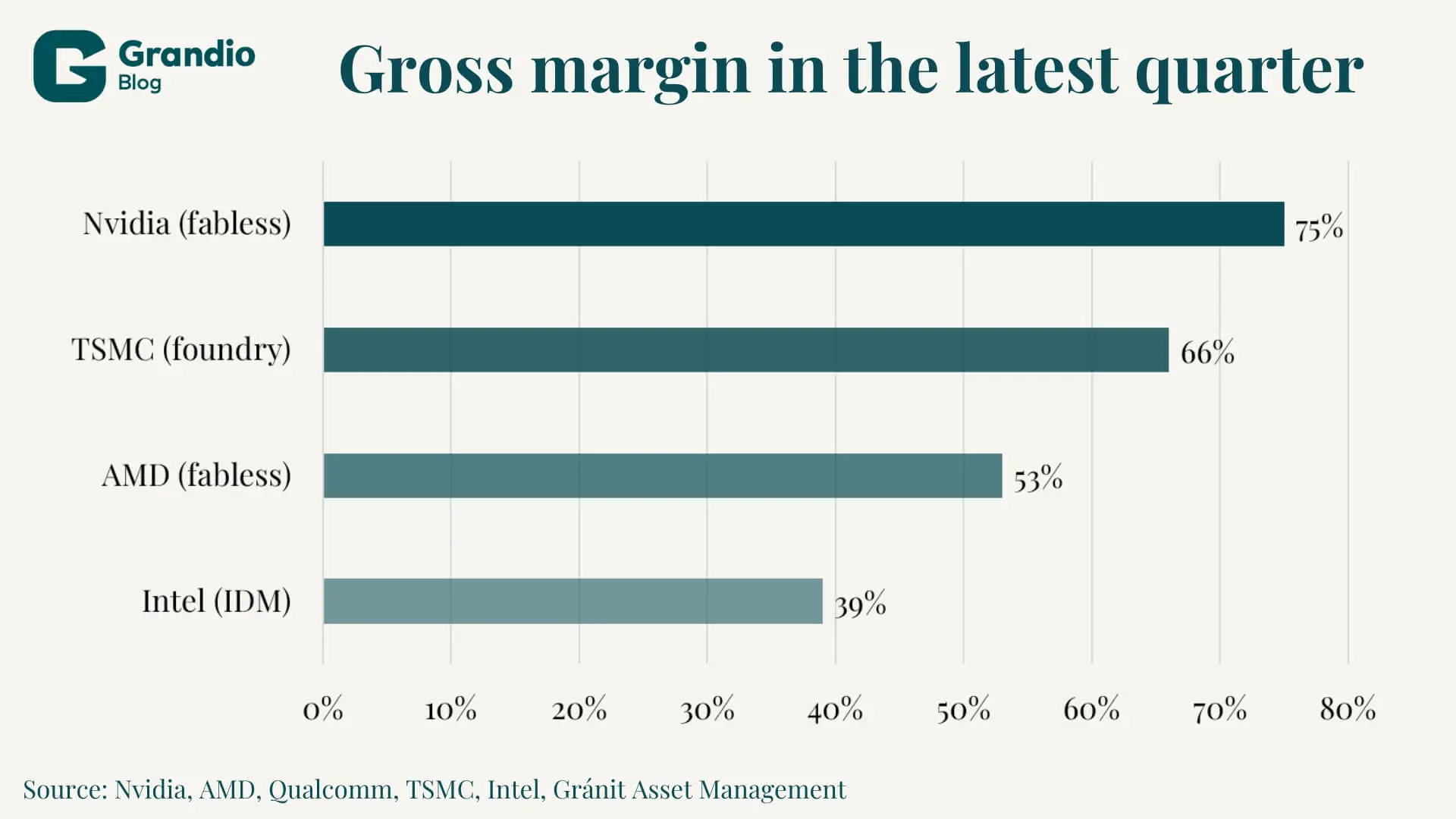
The market is now pricing in the possibility of a recovery in Intel’s foundry business. The figures nevertheless call for caution. Intel’s gross margin remained far below those of the industry’s leading companies in the first quarter of 2026, while its foundry division continued to report a substantial operating loss.
The lesson is not that owning semiconductor fabs is inherently a bad business. Rather, industrial policy rarely benefits only the companies that it is intended to support on paper.
The CHIPS Act sought to strengthen domestic manufacturing, yet the most visible stock market gains were captured by relatively capital-light design companies and suppliers of semiconductor manufacturing equipment. Intel’s attempted turnaround was also supported by the state becoming a direct shareholder in the company.
Investors considering beneficiaries of industrial support programmes should therefore examine the entire supply chain rather than focusing only on the companies receiving direct subsidies. They should also pay particular attention to the point at which the state moves from acting as a policymaker to becoming a direct market participant.

Legal Disclaimer
This document has been prepared by Gránit Alapkezelő Zrt. (registered office: 1134 Budapest, Váci út 17; company registration number: 01-10-046307) for marketing and informational purposes. Accordingly, it has not been produced in accordance with legal requirements designed to promote the independence of investment research. Nor is it subject to any prohibition on dealing ahead of the dissemination of investment research. This document does not constitute investment research or investment advice. Any data presented refers to past performance, and past performance is not a reliable indicator of future results. Each investor must make investment decisions at their own discretion and responsibility.